
English Below
El 60% de GLBTI se siente discriminado en los espacios públicos.
Cuando se trató de conseguir buenas notas en el estudio, Byron Peláez siempre destacó. De hecho obtuvo varios diplomas, pero ahora que dejó los años colegiales para trabajar, le ha costado obtener un empleo. Él es gay. “Al momento de conseguir trabajo rechazan la capacidad que yo tengo. Eso no es justo”, dice.
El joven llevó la voz de grupos GLBTI el pasado 27 de noviembre, día en el cual las autoridades de las Naciones Unidas, el Ministerio de Salud y la Defensoría del Pueblo suscribieron una declaración conjunta para poner fin a la discriminación de los grupos GLBTI.
Cuando se conmemora el Día Internacional de los Derechos Humanos, colectivos GLBTI abogan por hacer cumplir el precepto universal de “que todas las personas nacen libres e iguales en dignidad y derechos, sin excepción”.
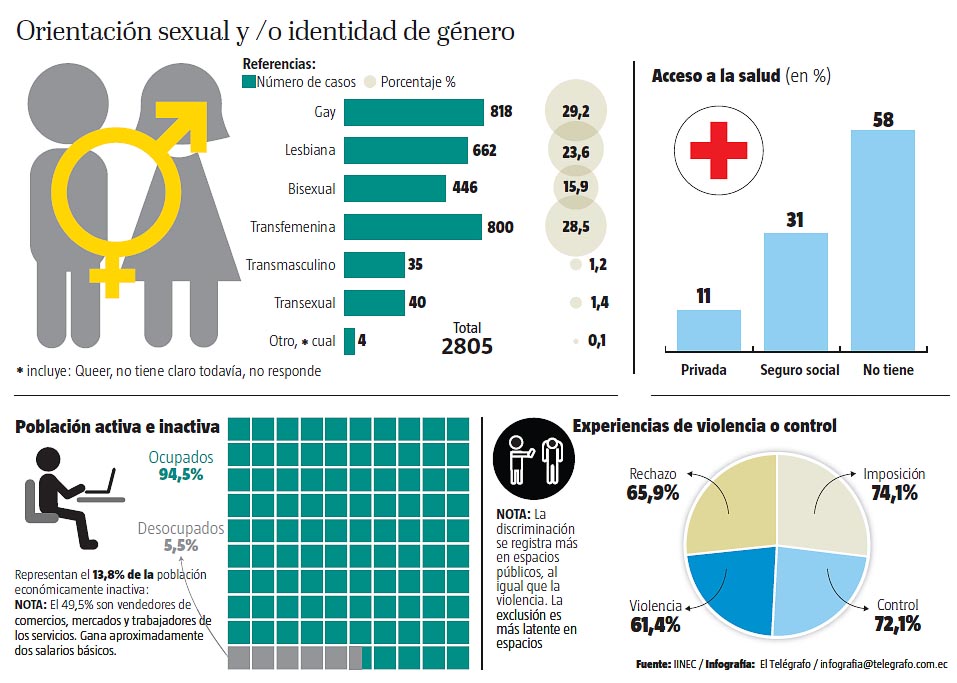
Un estudio del Instituto Nacional de Estadística y Censos (INEC) y de la Comisión de Transición para la definición de la institucionalidad pública que garantice la igualdad entre hombres y mujeres (CDT), demuestra que la discriminación, la exclusión y la violencia siguen latentes entre la comunidad GLBTI. Un 60% de los entrevistados se siente discriminado en espacios, sobre todo públicos.
En los ámbitos educativo, de justicia, salud y laboral también es perceptible la discriminación, tal cual lo siente Byron, quien considera que no encuentra empleo por su orientación sexual.
Solo el 11,3% de personas GLBTI se desempeña en el ámbito científico e intelectual, según el reporte.
Aunque la mayoría de los encuestados reconoce el derecho constitucional ecuatoriano, un 73,8% desconoce que el Código Penal desde el 2009 castiga los crímenes de odio con prisión de 12 a 16 años (muerte). Para el estudio se entrevistó a 2.805 personas GLBTI en la Costa y Sierra del país sobre sus condiciones de vida. (ver cuadro adjunto)
Pedidos de uniones legales
En Ecuador también se han logrado cambios a nivel legal. De hecho, el artículo 11 de la Constitución señala que: “Todas las personas son iguales y gozarán de los mismos derechos (…)”.
Si bien existen nuevas normas, hay impedimentos legales para que parejas del mismo sexo se casen o adopten niños.
Este año, Pamela Troya (31) y Gabriela Correa (32) protagonizaron un acto que dejó al descubierto un profundo anhelo de las parejas del mismo sexo: el matrimonio. Ambas son lesbianas y el próximo año cumplirán cinco años juntas.
En agosto acudieron al Registro Civil para contraer nupcias, pero esta opción les fue negada. Inmediatamente interpusieron una acción de protección y han encabezado la campaña “Matrimonio Civil Igualitario”. La semana pasada ocurrió lo mismo con Santiago Vinces y Fernando Saltos, que mostraron su deseo de contraer matrimonio en el Registro Civil de Guayaquil. Hoy, ellos presentarán otro amparo de protección.
En el mundo existen 14 países que reconocen el matrimonio homosexual, la mayoría en Europa. En América Latina se unieron a la tendencia: Argentina, Uruguay, Brasil y México (sistema federal).
Los pedidos de matrimonio, como el de Troya y Correa, las uniones de hecho y las solicitudes de cambio de sexo fueron analizados por el informe Acceso a la Justicia y Derechos Humanos, elaborado por el colectivo Silueta X.
En el documento se destaca que la sociedad ecuatoriana ha avanzado hacia una mayor tolerancia con las personas de distinta orientación sexual, pero sigue imperando “una herencia opresiva que toma nuevas formas de discrimen”.
Para conocer la percepción de los habitantes GLBTI en Ecuador, la organización realizó una encuesta. El 60% aseguró que fue víctima de discriminación. Solo un 33% denunció el hecho ante la Fiscalía o Defensoría del Pueblo. Más de la mitad abandonó el proceso porque cree que los operadores no hacen justicia.
“Sistemáticamente se siguen instaurando concepciones psicológicas equívocas, como el silencio o aislamiento… Una persona GLBTI se enfrenta a un sistema que no le permite el ejercicio real y respeto a sus derechos”, concluye el estudio.
+++++++++++++++++++++++
60% of GLBTI feels discriminated against in public spaces.
When it came to getting good grades in the study, Byron always said Pelaez. Indeed obtained several diplomas, but now that I left the college to work years, it has cost you to get a job. He is gay. «At the moment we refuse to get jobs that I have the ability. That’s not fair, «he says.
The young man’s voice took GLBTI groups last November 27, the day on which the authorities of the United Nations, the Ministry of Health and the Ombudsman signed a joint declaration to end discrimination against GLBTI groups.
When the International Human Rights Day, commemorating GLBTI groups advocate enforcing the universal precept «that all people are born free and equal in dignity and rights, without exception.»
A National Institute of Statistics and Census (INEC) and the Transition Commission for the definition of public institutions to ensure equality between men and women (CDT) shows that discrimination, exclusion and violence remain dormant between the GLBTI community. 60% of respondents feel discriminated spaces, especially public.
In the field of education, justice, health and labor is also perceptible discrimination, as it feels Byron, who believes not find employment because of their sexual orientation.
Only 11.3% of people GLBTI serves on the scientific and intellectual level, according to the report.
Although most respondents recognized the Ecuadorian constitutional right, 73.8% do not know that the Criminal Code since 2009 hate crimes punishable by imprisonment of 12 to 16 years (death). For the study interviewed 2,805 people GLBTI Coastal and Sierra the country about their living conditions. (see chart)
Offer legal unions
In Ecuador have also made changes to the legal level. In fact, Article 11 of the Constitution states: «All persons are equal and entitled to the same rights (…).»
While there are new rules, there are legal impediments to same-sex couples to marry or adopt children.
This year, Pamela Troy (31) and Gabriela Correa (32) staged an act that revealed a deep longing for couples of the same sex marriage. Both are lesbians and next year be five years together.
In August went to the Civil Registry to marry, but this option was they denied. Immediately filed a petition for protection and have led the campaign «Equal Civil Marriage». Last week was the same with Fernando and Santiago Vinces Saltos, who showed their desire to be married in the Registry Office of Guayaquil. Today, they presented another under protection.
In the world there are 14 countries that recognize gay marriage , mostly in Europe. In Latin America joined the trend : Argentina , Uruguay , Brazil and Mexico ( federal system).
Orders for marriage , such as Troy and Correa, domestic partnerships and requests for sex change were analyzed by the report Access to Justice and Human Rights , prepared by the collective Silueta X.
The document stresses that Ecuadorian society has moved towards greater tolerance for people of different sexual orientation, but still reigns » an oppressive legacy takes new forms of discrimination .»
To know the perception of GLBTI people in Ecuador , the organization conducted a survey . 60 % said they were discriminated against . Only 33 % reported the incident to the prosecutor or the Ombudsman . More than half abandoned the process because it believes that operators do not do justice .
» Systematically misleading continue instituting psychological concepts , such as silence or isolation … People GLBTI faces a system that allows the real exercise and respect for their rights, » the study concludes.
 Asociación Silueta X en Guayaquil y Quito Ecuador