
English Below
Fuente: http://www.andes.info.ec/es/noticias/15-septiembre-reconoceran-uniones-hecho-estado-civil.html
Desde el 15 de septiembre se reconocerán las uniones de hecho como un estado civil.
Las uniones de hecho entre personas del mismo sexo en Ecuador podrán inscribirse en el Registro Civil desde el próximo 15 de septiembre, lo que es reconocido como un avance por parte de colectivos que luchan por los derechos de los GLBTI, que anunciaron que estarán vigilando que la disposición se cumpla.
Según un comunicado oficial, el servicio se iniciará en las agencias de Quito, Guayaquil y Cuenca y se irá implementando paulatinamente en el resto de dependencias a nivel nacional.
El reconocimiento de las uniones de hecho de parejas del mismo sexo como estado civil en la cédula de identidad, la anunció el presidente Rafael Correa durante su informe semanal el pasado sábado. El primer mandatario recalcó que la unión de hecho para este grupo poblacional está establecida como un derecho constitucional y que un acuerdo con el Registro Civil permitirá ponerla en práctica.
Rashell Erazo, representante de la asociación «Alfil», señaló que es este es un avance muy importante en la lucha de los colectivos para que se cumpla el marco constitucional.
“Parte de esta incidencia y de este logro fue el almuerzo (…) de trabajo que mantuvimos el pasado 18 de agosto donde se habló con el Presidente sobre este tema”, dijo.
Erazo explicó que en conversaciones internas muchos compañeros mantienen el escepticismo de que no está puntualmente indicado que debe registrarse como un estado civil, sino como un dato complementario al estado civil, que puede traducirse de diferentes maneras.
“La resolución tiene cinco ítems. El segundo indica que el Registro Civil deberá inscribir la unión de hecho como un dato complementario al estado civil en la cédula, entonces hasta el 15 (de septiembre) en que será efectivo esto, lo que debe hacerse es asumirse como un estado civil como el matrimonio, la viudez o la soltería”, indicó.
Juan Pablo Guerrero, militante de «Silueta X», Quito -organización GLBTI, gays, lesbianas, bisexuales, transexuales e intersexuales-, sostuvo que la legalidad de este acto es un gran avance en materia de derechos, aunque confesó que le preocupa la aplicabilidad de la nueva normativa y vacíos en cuanto a cómo se debe realizar este proceso.
Agregó que la organización a la que pertenece realizó meses atrás una veeduría para analizar la factibilidad de registrar uniones de hecho en diversas notarías.
“Por ejemplo, nosotros fuimos a la Notaría Ocho en Quito, y al averiguar sobre la inscripción de una unión de hecho, la gente no tenía idea de costos. También nos pedían requisitos como cartas de conocimiento familiar, o nos decían que el tiempo que vivimos juntos no cubría una unión de hecho, o que no se podía hacer el trámite porque cuando iniciaron la relación un miembro de la pareja era menor de edad”, dijo.
Por este motivo, el militante aseguró que luego de que el servicio inicie en septiembre, los colectivos se mantendrán en alerta y realizarán pruebas de que las dependencias del Registro Civil estén capacitadas para realizar los trámites.
“Los estatutos pueden estar ahí, pero también hay que evaluar la apertura de la gente en este tipo de situaciones. Creo que todavía hay que trabajar mucho en la mentalidad de las personas antes estos temas”, aclaró.
Diane Rodríguez, directora de «Silueta X», Guayaquil, explicó que este reconocimiento social permitirá a las poblaciones de diversidad sexual, por ejemplo, asegurar los patrimonios cuando uno de los miembros de una pareja amparada por una unión de hecho fallezca. “Con esta aprobación la unión ya no solo quedará registrada en la solemnidad de una acta notarial, sino también se registrará en el documento de identidad”, informó.
Resaltó que las cuestiones de salubridad se facilitan porque cuando algún miembro de la pareja esté enfermo, el otro podrá decidir sobre la salud y métodos de curación de su conviviente, y además podrá amparar el compañero de vida, en los servicios que lo permitan.
El artículo 60 de la Constitución ecuatoriana ratifica que la unión estable y monogámica entre dos personas libres de un vínculo matrimonial, que formen un hogar de hecho bajo las condiciones que señala la ley, generará los mismos derechos y obligaciones que tienen las familias constituidas mediante matrimonio.
Correa reiteró que una unión de hecho entre heterosexuales o personas del mismo sexo es un derecho constitucional y de ser negado, las autoridades tomarán cartas en el asunto.
El acuerdo del Registro Civil se firmó el 22 de agosto de 2014 y ordena derogar la prohibición de ingresar la unión de hecho como un estado civil. Asimismo establece registrar las uniones de hecho como un dato complementario al estado civil y crear un registro especial para estas uniones.
+++++++++++++++++++++
Source: http://www.andes.info.ec/es/noticias/15-septiembre-reconoceran-uniones-hecho-estado-civil.html
From September 15 civil unions as a civil state be recognized.
De facto unions between persons of the same sex in Ecuador may register at the Civil Registry since the 15th of September, which is recognized as a breakthrough by groups fighting for the rights of GLBTI, who announced they will be watching you the provision is met.
According to an official press release, the service will start in the agencies of Quito, Guayaquil and Cuenca and will be gradually implemented in other departments nationwide.
The recognition of domestic partnerships for same-sex couples and marital status in the certificate of identity, President Rafael Correa said during his weekly report on Saturday. The president stressed that the unions for this population group is established as a constitutional right and that an agreement with the Civil Registry will allow its implementation.
Rashell Erazo, representative of the «Bishop» association, said that it is this is a very important step in the collective struggle to fulfill the constitutional framework.
«Part of this issue and this achievement was lunch (…) we kept working last August 18 where he spoke with the President on this issue,» he said.
Erazo said that in internal conversations many colleagues maintain that skepticism is not promptly indicated to be registered as a civil state, but as a complementary marital status, which can be translated in different ways data.
«The resolution has five items. The second indicates that the Registrar shall register the union in fact as a complementary data on marital status on the ballot, so until the 15th (of September) I will cash it, what should be done is assumed as a civil state as the marriage, widowhood or spinsterhood, «he said.
Juan Pablo Guerrero, member of «Silueta X» -organisation GLBTI Quito, gay, lesbian, bisexual, transgender and intersexuales-, said the legality of this act is a breakthrough in terms of rights, but admitted he was concerned the applicability of the new legislation and gaps regarding how to perform this process.
He added that the organization to which he belongs behind an oversight made months to analyze the feasibility of de facto unions registered in various notaries.
«For example, we went to Ocho Notary in Quito, and to find out about the registration of a union, people had no idea of costs. We also asked for requirements such as letters of familiar knowledge, or telling us that the time we live together not covered a union, or could not do the procedure because when they began the relationship one partner was underage «said.
For this reason, the militant said after the service to start in September, the groups will remain on alert and be tested for the civil registry are qualified to perform the procedures.
«The bylaws may be there, but we must also assess the openness of the people in such situations. I think we still have to work hard in the minds of people before these issues, «he said.
Diane Rodriguez, director of «Silueta X», Guayaquil, explained that this will allow social recognition of sexual diversity populations, for example, securing assets when one member of a covered by a common-law partner dies. «With this approval shall be binding and not only registered with the solemnity of a notarial act, but also register with the ID» reported.
He stressed that health issues are provided for when a partner is ill, the other may decide on health and healing methods of his partner, and also may cover the life partner in the services allow.
Article 60 of the Ecuadorian Constitution confirms that the stable and monogamous union between two people free of a marriage bond, forming a de facto household under the conditions prescribed by law, will generate the same rights and obligations of families constituted through marriage .
Correa reiterated a common-law heterosexual or same sex is a constitutional right and, if denied, the authorities will take action on the matter.
The agreement was signed on Civil Registration August 22, 2014 and ordered to repeal the prohibition of entering law marriage as a civil state. Record also establishes civil unions as a complementary data on marital status and create a special registry for these connections.
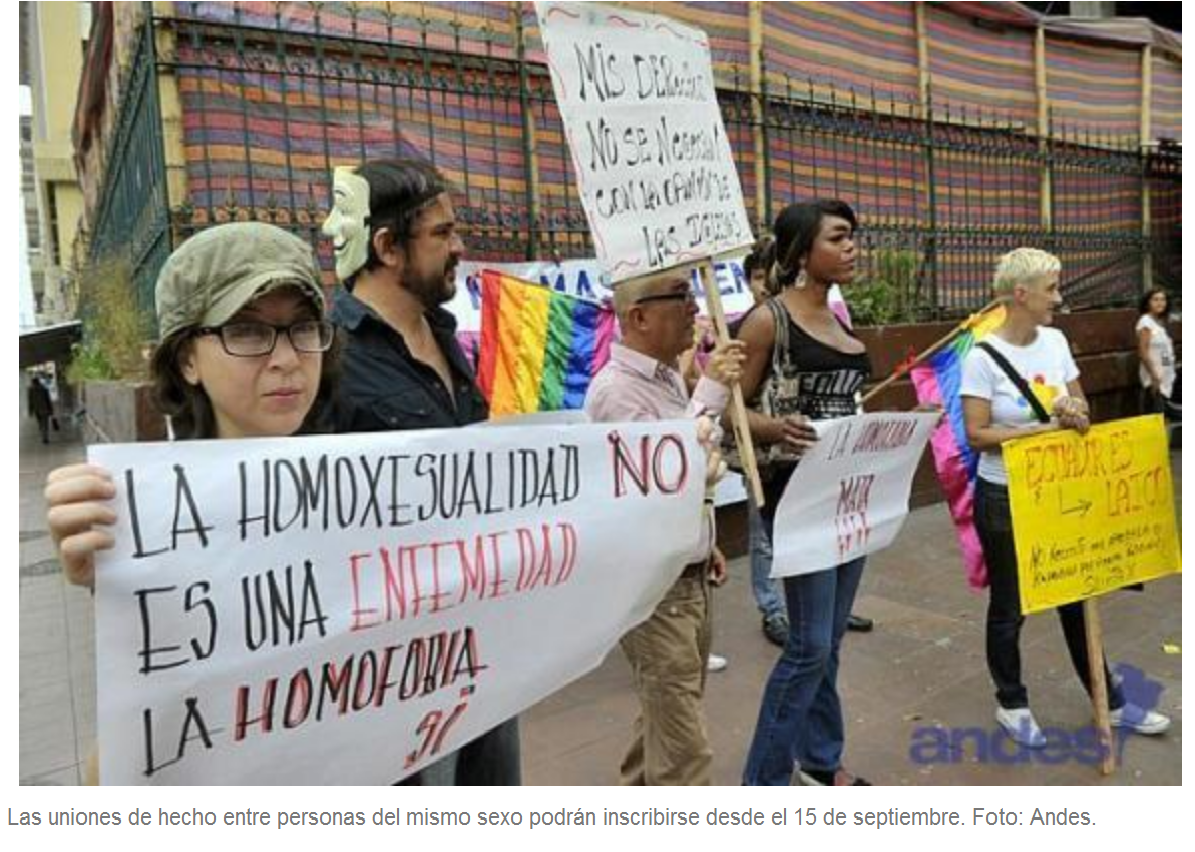
 Asociación Silueta X en Guayaquil y Quito Ecuador