English Below
¡Cambio de género en la cédula, un pedido urgente!
Emerson Rubio
E l año pasado, la Confederación Ecuatoriana de Comunidades Trans e Intersex (Confetrans), la Asociación Silueta X, Proyecto Transgénero y el movimiento Construyendo Igualdad presentaron un proyecto de reformas a la Ley del Registro Civil en el Ecuador, en el que se sustituye el sexo por el género en la cédula de ciudadanía.
La campaña “Mi género en mi cédula” acompañó a la ley que se expuso en la Comisión de Gobiernos Autónomos y Descentralizados de la Asamblea Nacional del Ecuador, el 23 de julio del 2012, informó Elizabeth Vásquez, redactora de la propuesta.
La experta explicó que el sexo es una característica natural y biológica que consta en la partida de nacimiento (hombre o mujer). Mientras que el género es cómo la persona se muestra a la sociedad (masculino o femenino).
“En la ley del Registro Civil actual, estipulada desde la década del 70, las personas sí pueden cambiarse de sexo, pero para lograrlo necesitan realizar un proceso jurídico, que podría resultar incierto, ya que depende de cómo lo entiendan los jueces”, indicó Vásquez.
“Por ejemplo, pueden pensar que una persona se hizo una reconstrucción genital o simplemente transitó de un sexo a otro hormonalmente, y para hacerlo creíble ante los funcionarios deben exponer fotografías frente a las autoridades, esto puede ser humillante”, añadió.
La redactora del proyecto explicó el caso de Estrella Estévez, una chica trans (hombre biológico), que realizó un proceso jurídico para lograr el cambio de sexo en la cédula.
En el 2001, la transexual presentó formalmente el pedido al Registro Civil, pero su solicitud fue rechazada por lo que apeló a la Defensoría del Pueblo. Luego de seis años de lucha constante, consiguió el cambio. En los registros de equidad de género consta como la primera trans femenina del Ecuador.
“La suerte de Estrella es que el trámite se lo hizo en el marco legal de la Constitución del 2008, que reconoce la identidad de género en el artículo 11, numeral 2”, indicó Vásquez.
Sin embargo, hay casos conocidos como el de Diane Rodríguez (hombre biológico), activista y presidenta de Silueta X, que aún tiene en su cédula de ciudadanía sexo masculino, a pesar de que su nombre sea el de una mujer, explicó Vásquez.
“A partir de ello se forma el problema más grave que enfrentan los trans. La discriminación laboral”, acotó.
La activista señaló que la gente rechaza a los y las trans cuando muestran sus documentos legales, ya que es visible comparar el sexo que está en la cédula y la apariencia. En este caso el género varía según los gustos, tradiciones o costumbres.
Agregó que el régimen del género no hace interferencia con el del matrimonio igualitario, pues ambos están por caminos distintos. Por ejemplo, que los hombres se cambian el género a femenino no quiere decir que logren contraer nupcias con un hombre, ya que el documento que habilita dicha acción es la partida de nacimiento, en la cual no se realiza ningún cambio.
Activista “Mi género en mi cédula”
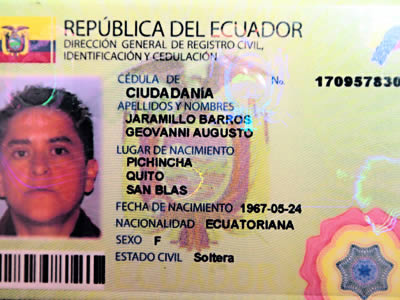
Geovanni Jaramillo es un chico trans (mujer biológica) que hizo activismo desde 1980. Ahora tiene 45 años y continúa ejerciendo la misma labor, a pesar de tener otras ocupaciones. Su nombre de nacimiento es Geovanna Jaramillo, pues únicamente lo cambió a masculino.
Geovanni cambió su nombre en la cédula de ciudadanía, pero el sexo sigue constando como femenino.
El trans contó que desde niño supo cuál era su orientación. “Siempre fui un hombre, lo que pasa es que nací en un cuerpo diferente”, añadió.
Estuvo en escuela de monjas y de allí pasó a un colegio fiscal. Del centro educativo lo expulsaron porque las autoridades descubrieron que tenía algunas novias dentro de la institución. Luego se dedicó a realizar artesanías en la calle y vivía de eso.
Cuando tenía 24 años conoció al amor de su vida, una chica trans (hombre biológico). Del fruto de ambos nació una niña, actualmente una jovencita lesbiana y activista Glbti.
“Lastimosamente en aquella época se creó el escuadrón volante, conformado por entidades policiales que tenían el fin de limpiar a la sociedad”, señaló Geovanni.
Según él, su conviviente fue víctima de dicho batallón, el cual tenía el sobrenombre de escuadrón “violante” para ellos, porque quienes pertenecían a este se dedicaban a abusar de las transexuales y travestis que laboraban en La Mariscal.
“Nunca volví a saber más de ella, la secuestraron y la mataron. Mi hija y yo nos quedamos solos”, mencionó.
Después de la muerte de su pareja recordó que cuando era joven su anhelo era ser un abogado, sin embargo, tuvo que retirarse del centro educativo, porque los mismos profesores lo discriminaban diciéndole que nadie va a contratar sus servicios. Ese tabú lo rompió hace tres años, cuando recibió su título de profesional e ingresó a trabajar en el Ministerio de Cultura del Ecuador.
Jaramillo ahora es parte de la campaña “Mi género en mi cédula” y asegura que la propuesta para reformar la ley del Registro Civil es inclusiva. Esta tiene el objetivo de permitir a las personas que han sido discriminadas toda su vida tengan igualdad de derechos.
Resaltó que la Constitución como carta magna debería obligar a las leyes menores, como la del Registro Civil, a equipararse con los derechos constitucionales para que se faculte la identidad de género.
++++++++++++++++++++++++++
¡Changing gender on the ballot, an urgent request!
Emerson Rubio
Last year, the Ecuadorian Confederation of Trans and Intersex Communities (CONFETRANS) Silueta X Association, Project Building Transgender Equality and the movement presented a draft amendments to the Civil Registry Law in Ecuador, which is replaced sex gender in the identity card.
The campaign «My gender on my card» accompanied the law discussed in the Committee on Decentralized Autonomous Governments and the National Assembly of Ecuador, on July 23, 2012, said Elizabeth Vasquez, editor of the proposal.
The expert explained that sex is a natural feature consisting in biological birth (male or female). While gender is how the person is to society (male or female).
«In the present Civil Registry Law, stipulated from the 70’s, people themselves can change their sex, but they need to make a legal process that could be uncertain, as it depends on how we understand the judges,» said Vasquez.
«For example, they may think that a person made a genital reconstruction or simply transitioned from one sex to another hormonally, and to make it believable to the officials must present photographs to the authorities, this can be humiliating,» he added.
The project editor for Star said Estévez, a girl trans (biological man), who conducted a legal process for change of sex on the ballot.
In 2001, the transsexual presented formally asked the registrar, but his application was rejected and appealed to the Ombudsman. After six years of constant struggle, got the change. In the records of gender equity is listed as the first female trans Ecuador.
«Luck Star is that the process made it legal under the 2008 Constitution, which recognizes gender identity in Article 11, paragraph 2,» said Vasquez.
However, no known cases like Diane Rodriguez (biological man), activist and president of Silueta X, he still has in his male citizenship card, even though his name is that of a woman, said Vasquez.
«From This forms the most serious problem faced by trans. Employment discrimination, «he said.
The activist said that people reject the trans and when they show their legal documents, as it is visible comparing sex is on the ballot and appearance. In this case the genre varies according to the tastes, traditions and customs.
He said the gender regime does not interfere with the equal marriage, as both are separate ways. For example, men are changed to female gender does not mean that achieve marry a man, as the document that enables such action is the birth certificate, in which there is no change.
Activist «My gender on my card»
Geovanni Jaramillo is a trans guy (biological woman) who made activism since 1980. Now is 45 years and continues to exercise the same job, despite having other occupations. His birth name is Geovanna Jaramillo, since only changed it to male.
Geovanni changed its name in the certificate of citizenship, but sex still consists as female.
The child said that since trans knew what his orientation. «I was always a man, what happens is that I was born in a different body,» he added.
He was in convent school and from there went to a school tax. He was expelled from school because the authorities discovered that he had some girlfriends in the institution. He then set about making crafts on the street and lived on that.
When she was 24 she met the love of his life, a girl trans (biological man). The fruit of both born a girl, now a young lesbian and LGBTI activist.
«Unfortunately at that time created the flying squadron, consisting of law enforcement agencies that were intended to cleanse the society» said Geovanni.
According to him, his partner was a victim of that battalion, which squadron was nicknamed «violante» for them, because those who belonged to this is engaged in abuse of transsexuals and transvestites who worked in La Mariscal.
«I never heard more of it, was abducted and killed. My daughter and I were left alone, «he said.
After the death of his partner recalled that when he was young his desire was to be a lawyer, however, had to withdraw from school because teachers would discriminate them saying that no one will hire their services. That taboo broke three years ago, when he received his professional degree and went to work at the Ministry of Culture of Ecuador.
Jaramillo is now part of the «My gender on my card» and ensures that the proposal to reform the Civil Registry Law is inclusive. This is intended to allow people who have been discriminated against all their lives have equal rights.
He stressed that the constitution as charter laws should require children, as the registrar, to be equated with constitutional rights to be empowered gender identity.