


The story a new generation deserves to inherit
Marriage equality was not a single day, a single lawsuit or a single organization. It was an accumulation of legal precedents, movement pressure, public storytelling, constitutional advocacy, court decisions and people willing to be among the first to use a newly recognized right.
For Silueta X, the path ran through a deliberate sequence: make family recognition workable, build public familiarity with LGBT+ couples, press institutions to move further, demand equal marriage once the constitutional opening became clear, and then help couples actually exercise the right.
Rights are built in layers
Before marriage equality, Ecuador had to make LGBT+ families legally visible
The 2019 breakthrough is easier to understand when it is seen as part of a longer movement arc rather than as an isolated court victory.
1997 · Decriminalization
First: stop treating same-sex intimacy as a crime
The decriminalization of consensual same-sex relations created the baseline from which later generations could fight over citizenship, identity, family recognition and equal access to civil institutions.
2001 · Marriage enters public debate
Early movement voices were already asking the marriage question
The historical archive preserved by the Federation and the campaign identifies Geovanni Jaramillo as publicly raising marriage for gay couples in 2001. That early advocacy is part of the broader movement history that predates the later national campaigns.
2008–2015 · De facto unions and civil recognition
Build a legal floor people could actually stand on
Article 68 of the 2008 Constitution recognized stable unions between two persons. Litigation, research into notarial barriers, government advocacy, Civil Registry Resolution 0174, the Unión Civil Igualitaria campaign and the 2015 Civil Code reform then moved that recognition from constitutional text into everyday civil registration.
Read the full Civil Union history →2016 · Marriage is already the next horizon
Civil-union recognition was not presented as the end point
A report preserved in the campaign archive documented Diane Rodríguez stating that the next objective in Ecuador was equal civil marriage. The same historical record described her decision not to marry in Ecuador until marriage itself was available on equal terms.
July 24, 2018 · Constitutional Court advocacy
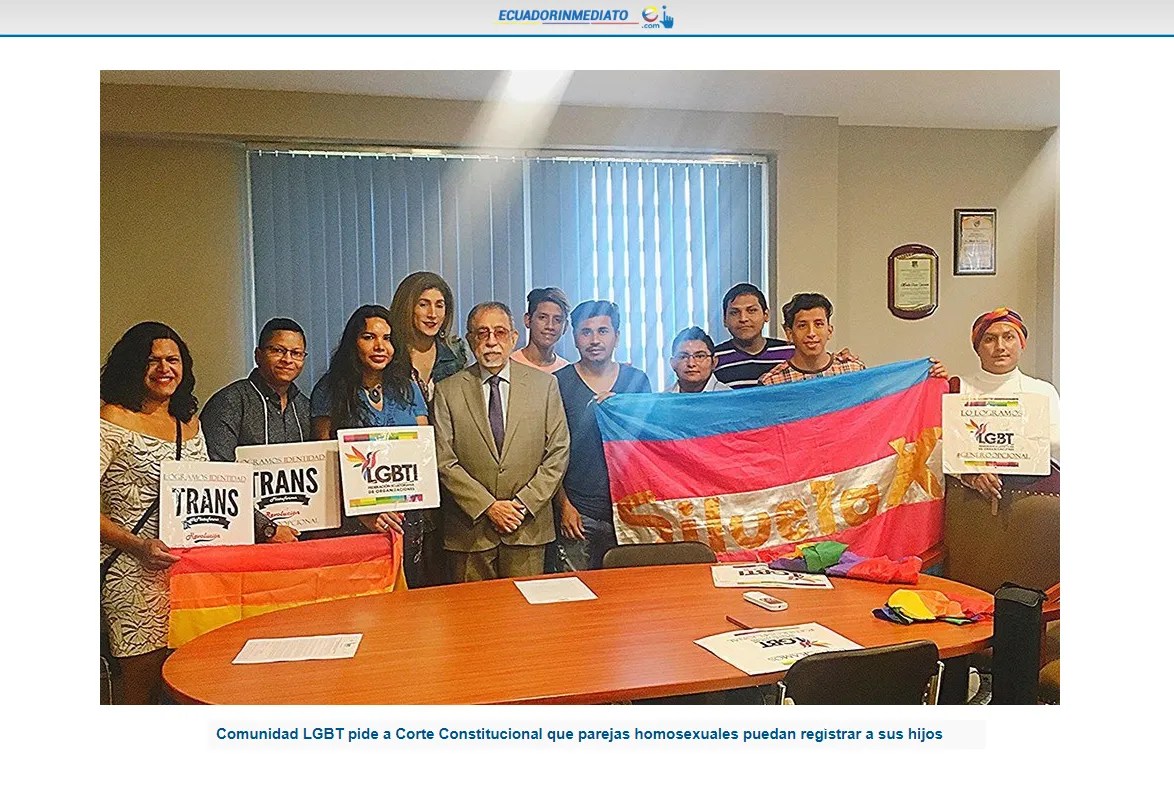
The marriage-equality campaign reached the doors of Ecuador’s highest constitutional institution
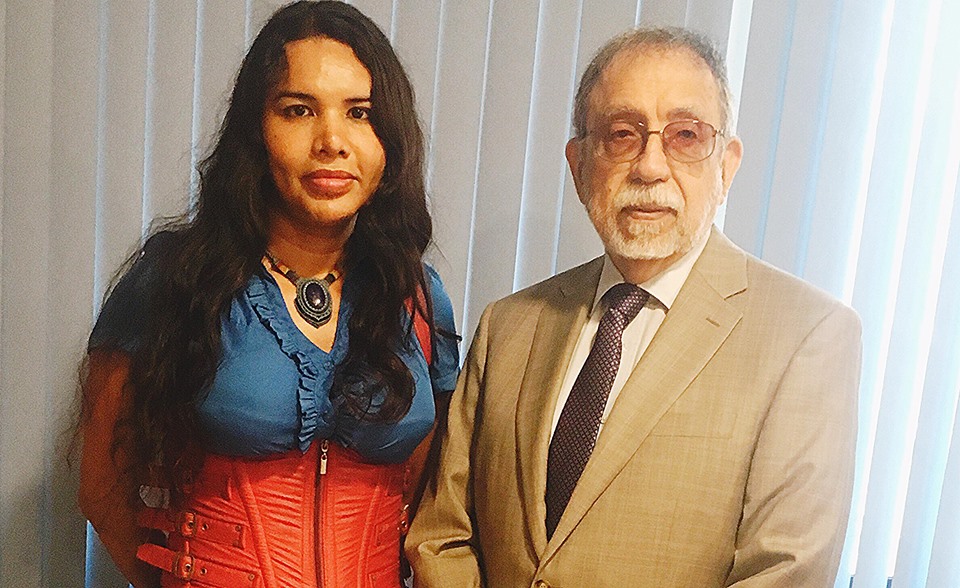
This meeting deserves a central place in the record because it shows institutional advocacy in action: organized LGBTQ+ civil society brought its demands, legal arguments and human-rights framing directly to the leadership of the Constitutional Court before the 2019 marriage rulings.
Access
The movement got in the room
The delegation was formally received by the Court’s president. That institutional access matters: the campaign was not only speaking to supporters or the media, but directly engaging the constitutional institution that would ultimately define the national legal framework.
Legal framing
OC-24/17 was placed at the center
The advocacy asked the Court to use Inter-American human-rights standards in future rulings affecting same-sex couples, including marriage and family recognition. This connected domestic constitutional advocacy to a regional rights framework.
Public accountability
The conversation did not stay behind closed doors
After the meeting, Diane Rodríguez publicly reported that the Court’s president had indicated a majority favorable to recognition if a marriage case reached the Court. La República and EFE carried those statements nationally.
Why this meeting belongs in the marriage-equality timeline
The meeting did not decide the later judgment, and the judges who issued the 2019 marriage-equality rulings were a different Court composition. Its importance lies elsewhere: it is documented evidence that Silueta X and the Federation were doing direct constitutional advocacy before the final rulings — taking community demands, OC-24/17 and the marriage question face-to-face into the institution.
In movement terms, this is the difference between simply supporting a cause and building institutional pressure, public expectation and an accountability narrative around it.
2019 · Court-watch advocacy before the ruling
Inside the institution in 2018. Public pressure outside it in 2019.
By May 2019, the Federation was publicly tracking the Court’s deadlines, identifying multiple pending marriage cases and warning that organized LGBT+ civil society could hold a demonstration if a ruling did not arrive. This was classic court-watch and accountability advocacy: keeping the issue visible while litigation moved through the system.
May 2019
Make institutional delay visible
The Federation told national media that multiple couples were waiting and that the Court’s answer would define whether the institution acted as a guarantor of rights or as a barrier to them.
Movement leverage
Litigation needs a public ecosystem
Lawyers and claimant couples move cases through court. Movement organizations build public understanding, political attention, community legitimacy and the social expectation that institutions will answer.
June 2019
A victory framed as nearly two decades of struggle
After the ruling, Thomson Reuters Foundation / Global Citizen quoted Diane Rodríguez describing the breakthrough as the result of an almost twenty-year fight — a framing that located 2019 inside a much longer national movement history.

June 12 → July 8, 2019
First the decision. Then official publication and implementation.
The Constitutional Court decided the marriage cases on June 12, 2019. Judgments 10-18-CN/19 and 11-18-CN/19 were published in Constitutional Edition No. 96 of Ecuador’s Official Gazette on July 8, 2019, opening the administrative implementation stage.
A historical campaign bulletin published on July 9 mistakenly referred to “June 8” as the Official Gazette publication date. The official source confirms July 8, 2019. Preserving movement history also means correcting material errors when authoritative records allow us to do so.
Winning the case was not the end of the work
The implementation phase: Matrimonio Homosexual Ecuador
The former Unión Civil Igualitaria portal evolved into a marriage-focused platform: judgments, requirements, couple registration, public education and hands-on support. The campaign archive attributes this implementation phase to coordination among Silueta X and the Federation, with support from the LGBT+ Chamber of Commerce Ecuador.
Legal literacy
Turn a landmark ruling into understandable steps
The campaign translated a complex constitutional victory into practical questions: what couples needed, where to go, how to book, and how to exercise the right through the Civil Registry.
Community pipeline
Identify couples ready to marry
The website opened a registration channel for couples who wanted to marry, including Ecuadorians living abroad, creating a national network of people ready to turn constitutional doctrine into lived reality.
Access fund
Rights still have costs
The campaign documented financial support for couples with fewer resources so that fees, paperwork and, in some cases, part of a public celebration would not become the next barrier to equality.
The campaign started measuring demand
57 → 67 → 71 → 172
These figures come from the campaign’s own registration system and bulletins; they are not presented as official Civil Registry statistics. Their value is movement-organizing evidence: they show how quickly demand grew once couples understood that the right was real and usable.
July 2019 · Rights become lived experience
Three public weddings helped show the country that marriage equality was no longer theoretical
The campaign made real couples visible in different family configurations. They were not abstract symbols: they were people showing up, signing, celebrating and teaching thousands of others that the new right could actually be used.


Archive note: historical 2019 publications contain spelling variants in some names. This page prioritizes the forms preserved in the campaign’s “Parejas” archive and the names supplied by the historical project record.
What this archive can document with confidence
Give every part of the movement its place — including the advocacy that happened before the ruling
Claimant couples
They created justiciable cases
R.D.S.G. and C.D.V.R. challenged the Civil Registry’s refusal and generated the constitutional consultation that became case 10-18-CN. Other couples and legal actions formed part of the wider judicial landscape that reached the Constitutional Court.
Constitutional Court
It transformed the legal framework
The June 12, 2019 rulings made civil marriage available to same-sex couples and removed statutory restrictions incompatible with equality and non-discrimination.
Silueta X + Federation
They built movement pressure and institutional access
The record shows continuity from de facto-union advocacy to explicit marriage demands, direct engagement with public authorities, a face-to-face July 2018 meeting with Constitutional Court President Alfredo Ruiz, public advocacy for the application of OC-24/17, national court-watch pressure in 2019 and later support for couples using the right.
LGBT+ Chamber Ecuador
It resourced implementation
The Chamber contributed funding, organizational infrastructure and support to early couples, turning marriage equality into a social-responsibility initiative with practical outcomes.
The wider LGBTQ+ movement
The victory was larger than any one organization
The history includes early advocates, claimant couples, lawyers, human-rights organizations, families, local collectives, Inter-American standards and multiple movement strategies. Preserving Silueta X’s documented role does not require flattening that plural history.
Core sources
Campaign archive + official court records + contemporaneous reporting
Memory, archive and intellectual property
Preserving the archive also means preserving provenance
The research, selection, organization and contextualization of this historical compilation form part of Asociación Silueta X’s memory work. Bulk extraction, repackaging or commercial exploitation of the compilation is not authorized without permission.
Official documents: judgments and government publications retain their public nature and institutional provenance. Press: rights in third-party articles and images remain with their respective rights holders.
Campaign archive: logos, photographs, bulletins and historical materials are presented for memory, research, education and human-rights documentation.
Historical note on strategy and language
What the archive shows about the transition from civil-union advocacy to marriage equality
Did the earlier Unión Civil Igualitaria campaign mean abandoning marriage equality? The preserved record says no. By 2016, marriage was publicly identified as a next objective; in January 2018 the Federation explicitly called on the State to recognize it; in July 2018 Silueta X and Federation-linked groups took the issue directly to the leadership of the Constitutional Court; and in 2019 the Federation publicly pressed the Court to rule.
Different activists and organizations used different strategies and sometimes disagreed strongly about sequencing, tactics and political context. This page does not treat those disagreements as the gateway to the history. For a new generation, the more useful record is the documentary sequence of what was built, what was litigated, what was advocated, what institutions changed, and how couples finally accessed the right.
Terminology: “Matrimonio Homosexual Ecuador” is preserved as the campaign’s historical name. Contemporary English uses marriage equality, same-sex marriage, LGBTQ+ couples and LGBTQ+ rights movement. Retaining the historical brand does not mean reducing a relationship to the sexual orientation or gender identity of the people in it.
The right is now part of everyday life
Want to marry in Ecuador or facing a civil-registration problem?
Historical 2019 requirements should not be treated as current legal instructions. If you are dealing with marriage, identity documents, nationality, recognition of a relationship or discriminatory treatment, use current official information and obtain legal guidance when necessary.
Legal support
Consultorio Jurídico X
The Consultorio Jurídico X de la Asociación Silueta X, miembro de la Federación Ecuatoriana de Organizaciones LGBT can provide guidance on current legal barriers involving recognition of rights.
Contact Consultorio Jurídico X →Official information
Ecuador Civil Registry
Before starting a procedure, verify current requirements, fees, appointments and documentation through the Civil Registry’s official channels.
Open the Civil Registry Virtual Agency →
