
Asociación Silueta X · Ecuador · SIEC Methodology Since 2008
Inclusive Security & Peace X
SIEC Program for Institutional Capacity Strengthening across Public Security and Justice Institutions
Human Rights · Diversity · Non-Discrimination · Access to Justice · Institutional Trust · Peacebuilding
Inclusive Security & Peace X transforms Silueta X’s longstanding experience in awareness-raising, information, education and communication into a contemporary institutional-capacity program designed to strengthen rights-based responses across security and justice systems.
Human-rights-based security
Better-prepared institutions can provide more effective, dignified and non-discriminatory responses.
Inclusive Security & Peace X strengthens knowledge, practical skills and institutional capacity so that police and other public security and justice actors can respond more effectively to discrimination, violence, vulnerability and human-rights concerns.
The program does not replace the responsibilities or official training systems of public institutions. It contributes civil-society expertise, community knowledge and rights-based approaches that can strengthen institutional practice.
Our methodological foundation
SIEC is not being replaced. It is evolving.
SIEC was launched in Guayaquil in 2008 and later expanded territorially and nationally. Today, Silueta X is systematizing that experience as an adaptable institutional-capacity model.
SIEC retains its original Spanish acronym: Sensibilización, Información, Educación y Comunicación.
Awareness
Examine bias, lived experience, inequality and barriers that can influence institutional interactions.
Information
Human-rights standards, concepts, legal frameworks, evidence, institutional pathways and case analysis.
Education
Develop competencies that can be applied to operational situations, public duties and institutional decision-making.
Communication
Respectful interaction, listening, communication with victims and stronger relationships between institutions and communities.
Documented experience
From a local initiative to an institutional-capacity platform
Institutional evidence
This work did not begin with a funding proposal. It has a documented institutional history.
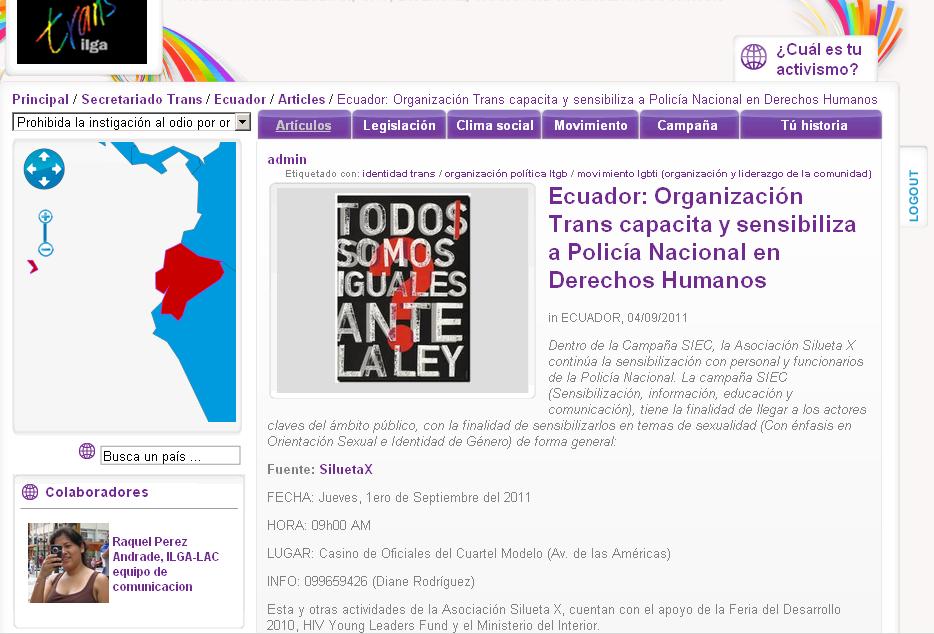
In November 2013, the Human Rights Department of Ecuador’s National Police Directorate of Education formally requested that Silueta X train 70 police officers serving as human-rights instructors.
The request addressed the rights of sexually diverse people, gender identity and sexual orientation, and anticipated subsequent replication of the training within police units.

Institutional counterparts
An adaptable program for the security and justice ecosystem
Program scope is defined with each institutional counterpart or donor. Different institutions require different competencies, modules and implementation approaches.
Beyond a training session
Institutional engagement matters
Silueta X’s trajectory also includes engagement with public authorities to advance human rights, diversity and non-discrimination within institutional processes.
This history supports a program model that can combine training with technical dialogue, institutional recommendations, capacity development and relationships between public institutions and civil society.
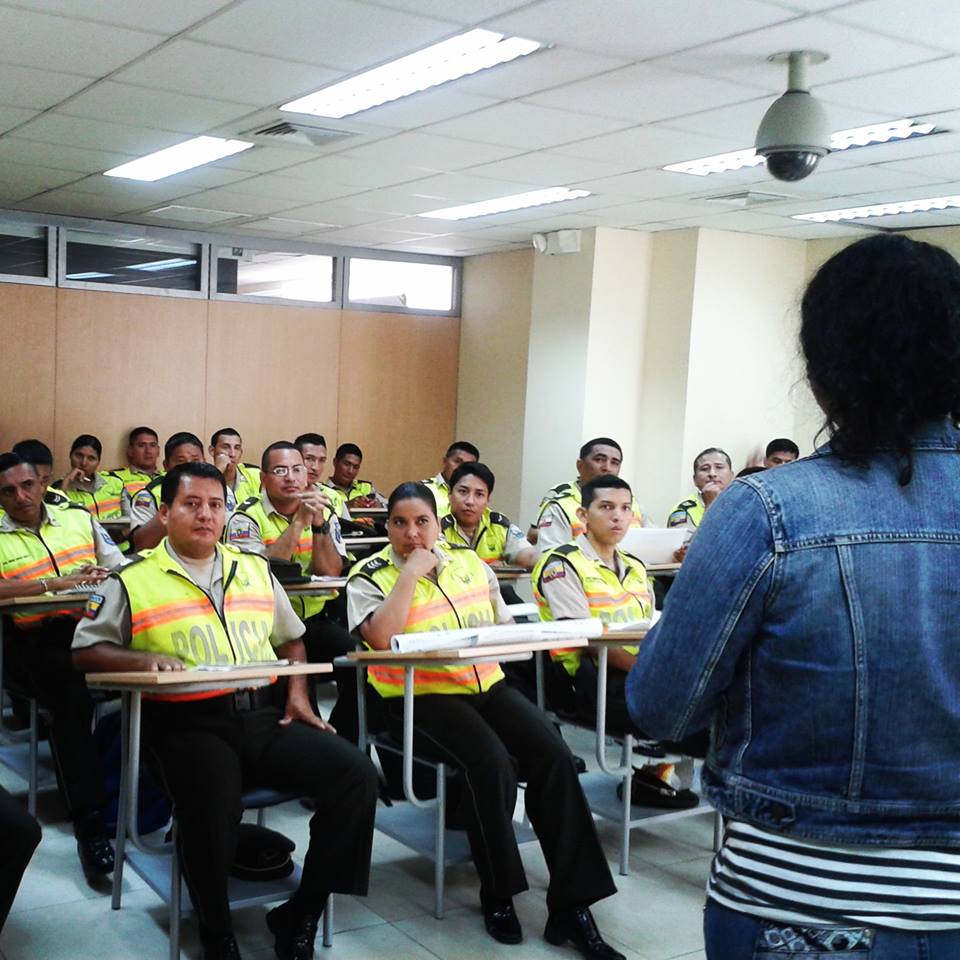
Transparency note: this photograph documents institutional engagement with public authorities. It is not presented as a photograph of training delivered to prosecution or judiciary personnel.
Program architecture
Five components to move from knowledge to institutional practice
SIEC Training
Human rights, diversity, sexual orientation, gender identity and expression, intersectionality and non-discrimination.
Inclusive Security
Victim response, operational interaction, dignified treatment, referrals, prevention of abuse and police–community trust.
Access to Justice
Violence, discrimination, victim-centered responses, bias indicators, investigations and prevention of revictimization.
Institutionalization
Training of trainers, tools, materials, protocols, recommendations and replicable institutional capacities.
Trust & Peacebuilding
Institution–community dialogue, violence prevention, identification of barriers and trust-building.
Adaptable curriculum
A common human-rights foundation with institution-specific modules
Dignity, equality, protection, public duties and institutional responsibilities.
Sexual orientation, gender identity and expression, sex characteristics and non-discrimination.
Identity, names, pronouns, documentation, dignified treatment and prevention of discriminatory profiling.
Listening, interviewing, referrals, protection, dignity and prevention of secondary victimization.
Recognizing possible bias indicators and preserving relevant contextual information.
Diverse women, gender-based violence and intersectional vulnerabilities.
Migration, asylum, displacement and overlapping vulnerabilities.
Communication, prevention, community engagement, trust and constructive institutional dialogue.
Evidence-informed learning
SIEC can now learn from patterns and cases documented through Runa Sipiy.
Silueta X’s human-rights monitoring creates opportunities to connect institutional training with evidence about violence, barriers to justice, institutional responses and the lived experiences of affected communities.
Case-based learning can be anonymized or pedagogically adapted and should always protect privacy, dignity and the safety of victims and affected people.
Theory of change
Knowledge → Skills → Practice → Trust → Justice → Peace
Institutional scalability
Train the people who can train others
Silueta X’s 2013 experience demonstrates the potential of working with institutional instructors rather than relying only on one-off training sessions.
A training-of-trainers component can support institutional ownership, internal replication and longer-term sustainability.
Monitoring, evaluation & learning
Institutional capacity should be more than a training attendance list
Each funded project can establish indicators appropriate to its institution, duration, target population and scope.
For funders & international cooperation
An opportunity to invest in peace, justice and more inclusive institutions
Inclusive Security & Peace X can be developed through institution-specific projects with public counterparts, international cooperation, foundations, universities, embassies and specialized organizations.
Sustainable Development
Inclusive Security & Peace X contributes to peace, justice and stronger institutions.
The program connects institutional capacity, human rights, violence prevention, access to justice, non-discrimination and trust-building.
SDG 16 · Peace, Justice and Strong Institutions
Institutional archive & traceability
Public records behind the program
Inclusive Security & Peace X systematizes experiences that were historically distributed across projects, training activities, official requests, institutional advocacy and public records.

