
Historical Memory · Human Rights · Ecuador
Achievements and Advocacy of Silueta X
From the streets to the Constitution. From identity documents to the Constitutional Court. Two decades turning community demands into rights, precedents and public policy.
This is not a list of activities. It is a documented reconstruction of moments when Silueta X — directly or as part of broader coalitions — helped change a rule, secure a remedy, open an institution, produce evidence or place a right firmly on Ecuador’s public agenda.

Not every achievement carries the same weight
How to read this history
A Constitutional Court ruling that changes how a national right can be exercised is not equivalent to participating in a technical manual. Both matter, but they represent different levels of transformation.
Highest impact
Changed a rule of the State
Laws, court rulings, identity rights or national decisions that structurally changed how people exercise their rights.
Justice
Remedied a rights violation
Court decisions, administrative rulings, public apologies, reinstatement or precedents addressing discrimination.
Government
Changed public policy
Protocols, manuals, procedures and technical contributions incorporated into government institutions.
Knowledge
Created evidence
Research, reports, observatories and data capable of turning isolated experiences into documented patterns.
Citizenship
Opened a new space
Political representation, democratic participation, economic inclusion, community services and new institutions.
Structural change and precedent
Victories that changed more than the conversation
These milestones produced some of the most significant legal, administrative or institutional consequences.
From community organizing to the constitutional moment
The genealogy of Silueta X reaches back to networks of trans women engaged in sex work who began organizing before the institutional name was fully established. The organization’s historical memory places these activists within the wider social advocacy surrounding the drafting of Ecuador’s Constitution in Montecristi.
Ecuador’s 2008 Constitution expressly included gender identity and sexual orientation within its constitutional protections against discrimination.
A person’s legal name stopped being an immovable barrier
Diane Rodríguez’s struggle with Ecuador’s Civil Registry, while leading Grupo Femenino Silueta X, helped open one of the country’s first major public debates over changing traditionally male names to female names and made legal identity a national trans rights issue.
De facto unions moved from constitutional text to the Civil Registry
Research, public pressure, dialogue with the Executive and the Unión Civil Igualitaria campaign helped turn a constitutional guarantee into an actual registration procedure available to same-sex and trans couples.
Comedy was forced to answer for discrimination
Silueta X’s complaint against La Pareja Feliz resulted in an administrative finding against Teleamazonas for discriminatory content based on sexual orientation and led to a public apology.
De facto union became a legally recognized civil status
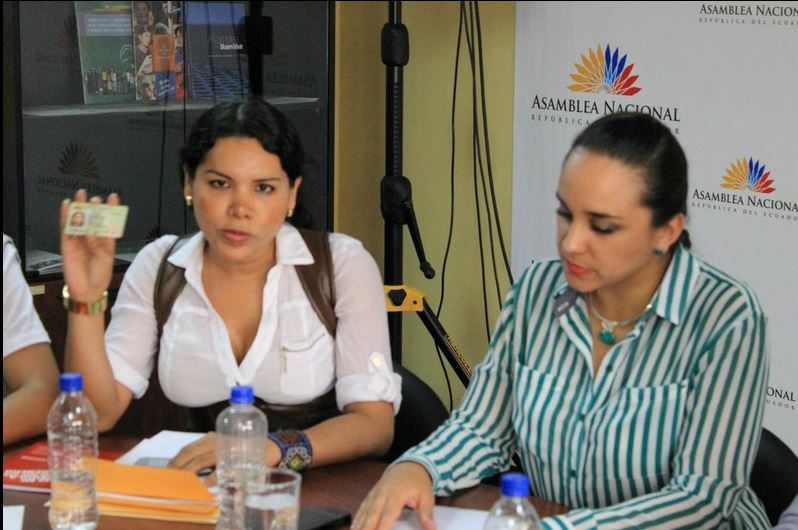
Following the administrative breakthrough of 2014, advocacy continued in the National Assembly. Reform of the Civil Code formally recognized de facto union as a new civil status, giving legislative force to a demand previously brought before Assembly President Gabriela Rivadeneira.
Gender reached the national identity card
After years of legislative and Civil Registry advocacy, Ecuador’s identity framework allowed trans people to replace the sex field with gender. Silueta X and allied trans organizations continued pressing for effective implementation through the Civil Registry and electoral system.
November 27 entered Ecuador’s official national memory
Under the Federation’s umbrella, advocacy involving Silueta X, the GLBTI Observatory and Es mi Familia reached the National Assembly floor. Session Record 393 shows that the legislative amendment explicitly took up a request made by LGBTI representatives.
Pride defended its right to march through the courts
After Guayaquil’s municipal authorities refused to maintain the historic downtown route, organizations within the Pride Committee activated constitutional remedies. A parallel citizen action secured the decision that allowed the march to return to Avenida 9 de Octubre.
Judgment 66-18-IS/24
The enforcement action pursued by Diane Rodríguez as part of Asociación Silueta X led Ecuador’s Constitutional Court to examine failures to comply with obligations involving trans legal identity and assisted human reproduction for diverse families.
2006 → 2026
A timeline of advocacy and transformation
The path was never linear. Sometimes a law changed. Sometimes evidence was created, an institution was opened or discrimination finally carried consequences.
2008
Early community networks and Montecristi
The organization’s roots lie in networks of trans women engaged in sex work before a formal legal structure existed. The name Grupo Femenino Silueta X is documented from May 2008. Institutional memory places these activists within the wider advocacy environment surrounding Ecuador’s new Constitution, whose Article 11.2 expressly protected gender identity and sexual orientation against discrimination.
Changing names opened a legal door for trans identity
Diane Rodríguez’s dispute with Ecuador’s Civil Registry over changing her legal names became one of Silueta X’s first major public battles over the right of trans people to have identity documents that reflect who they are.
Trans entrepreneurship and legal incorporation
International recognition for an economic inclusion and trans entrepreneurship initiative helped strengthen the transition from Grupo Femenino Silueta X into a legally established organization. Asociación Silueta X obtained formal legal recognition on May 5, 2010.
HIV data, educational inclusion and a presidential apology
With support from amfAR, Silueta X carried out community-based research involving 767 trans women in Guayaquil and other coastal cities, examining health, HIV and human rights.
During the same period, Silueta X and a trans student challenged discrimination at a military school. The process ended with her being allowed to continue her education while presenting as female and, according to the institutional record, using the corresponding uniform and women’s restroom.
In August, several organizations including Silueta X demanded a correction after homophobic remarks by President Rafael Correa. The President subsequently issued a public apology.
A year of community infrastructure
In May, Silueta X opened in Guayaquil what it documented as the country’s first psycho-medical center specializing in transsexuality, developed within a pilot supported by Hivos.
Silueta X published its first major Access to Justice and Human Rights Report covering 2010–2013, analyzing approximately 159 cases. According to the project’s institutional memory, this stage also received support from WEMI through USAID. This documentation model later evolved into the annual Runa Sipiy monitoring system.
Diane Rodríguez also ran for the National Assembly as Ecuador’s first openly trans legislative candidate, bringing trans political representation into a nationwide electoral contest.
In December, after months of requests, LGBTI organizations held a historic meeting with President Rafael Correa, opening a new stage of direct government dialogue on identity, civil registration, families, health and violence.
Three different fronts of advocacy
Unión Civil Igualitaria: sustained advocacy helped make de facto unions actually registerable, accompanied by public campaigns in several cities and the first highly visible registrations.
Humor without discrimination: Silueta X’s complaint against La Pareja Feliz resulted in an administrative finding against Teleamazonas and a public apology.
Media research: with collaboration from the Inter-American Development Bank, Silueta X analyzed 591 press publications from 1990–2013 to examine the relationship between media language, violence and legal changes involving sexual orientation and gender identity.
De facto union became a new civil status
Advocacy carried into the National Assembly after the 2014 administrative breakthrough. With 89 votes, reform of the Civil Code recognized de facto union as a civil status, meaning the right no longer depended solely on an administrative Civil Registry resolution.
Identity, national memory and the prison system
Gender on the ID card: Ecuador implemented the procedure allowing trans people to replace the sex field with gender on their national identity documents.
November 27: Ecuador’s National Assembly recognized the National Day of Sexual and Gender Diversity following advocacy by LGBTI representatives organized under the Federation.
People deprived of liberty: a national protocol was launched to protect the dignity, identity, privacy and treatment of LGBTI people in prisons, with participation from the Federation and Silueta X.
Rights in everyday family life: the same cycle of civil-registration reforms also enabled public use of new family-registration rules, including the ordering of surnames when registering children. Out of respect for family privacy, this page records the milestone without using photographs or identifying relatives who do not wish to be publicly exposed.
From community pilots to a Ministry of Health tool
Silueta X and organizations within the Federation participated in the development and dissemination of Ecuador’s Ministry of Public Health manual for comprehensive health care for LGBTI people. Institutional memory links this process to the practical protocols developed through Silueta X’s earlier psycho-medical pilot.
The same period marked another barrier broken in representation: Diane Rodríguez went on to exercise legislative functions as an alternate National Assembly member.
2019
Intersex health policy and Ecuador’s first LGBT Chamber of Commerce
In 2018, Silueta X participated in technical processes connected to Ministry of Health guidance concerning people with variations or differences in sex development.
At the same time, the idea of a business organization focused on diversity was taking shape. In March 2019, Ecuador’s first LGBT Chamber of Commerce was publicly launched in Quito with support from civil-society actors including Silueta X.
In 2019, Silueta X and the Federation also took part in public advocacy and the practical implementation of marriage equality, without claiming ownership of the original Constitutional Court cases that established the right.
Trans Pride and new constitutional frontiers
Trans Pride Ecuador was launched, reclaiming November 27 through an explicitly trans agenda: remembering decriminalization, defending the national recognition achieved in 2016 and demanding justice for trans people who had been killed.
Constitutional advocacy also deepened around diverse families and State compliance, including the action that would later result in Judgment 66-18-IS/24.
Trans Employment Inclusion Bill
Silueta X drafted a proposal addressing trans access to employment with contributions from Asociación Transmasculinos Ecuador, legal review by the LGBT Chamber of Commerce and support from Plataforma Nacional Revolución Trans. It was formally delivered to Ecuador’s National Assembly on March 22. Its submission is an advocacy milestone; its passage remains pending.
Three new frontiers of rights
Guayaquil Pride: two judicial actions converged against the municipality’s refusal to maintain the downtown Pride route. The resulting judicial decision restored the right to demonstrate along the historic route.
Zack Elías: Silueta X’s current director won a constitutional protection action against the Ministry of Women and Human Rights. Zack was the claimant; Diane Rodríguez participated as amicus curiae. The court found rights violations and ordered remedies, including a public apology.
Non-binary recognition: a request to the Civil Registry to change the recorded gender from female to non-binary reached Ecuador’s Constitutional Court through constitutional consultation case 35-23-CN. The issue remains pending and is not presented as a completed victory.
2025
Court decisions requiring the State to act
Judgment 66-18-IS/24 transformed years of monitoring State non-compliance into new Constitutional Court orders involving identity records and assisted reproduction.
In the case of a trans girl in Santa Elena, Silueta X participated as amicus curiae and later took part in technical spaces connected to implementing educational standards for trans children and adolescents. The original litigation belonged to the affected family and is not claimed as Silueta X’s lawsuit.
Visual archive
Advocacy also left a visual record


Justice and remedy
When discrimination carried consequences
We do not count how many complaints were filed. We look at what changed after intervention.
A journalist exposed a member’s trans identity
The historical archive records that a reporter publicly disclosed the trans identity of a Silueta X member who had not made that information public. Intervention ultimately resulted in a public apology.
A trans student was able to remain in school
Following a complaint by Silueta X and the student against Colegio Militar Huancavilca, she was permitted to continue her education while expressing her female identity. Institutional memory also records recognition of the corresponding uniform and restroom.
A President was forced to correct the record
Silueta X joined other organizations in responding publicly to homophobic remarks by Rafael Correa. The pressure was followed by a public apology from Ecuador’s then-President.
La Pareja Feliz
Silueta X’s complaint resulted in a formal finding concerning discriminatory content and required Teleamazonas to issue a public apology. Silueta X’s role is presented separately from later proceedings and sanctions involving the program.
Pride returned to downtown Guayaquil
The municipality’s refusal prompted two constitutional actions. The Pride Committee and LGBT Chamber pursued one; the first was filed by law student Emilio Sánchez Medina and secured the decision that allowed the central-city march to proceed. It was a converging civic victory.
Zack Elías v. Ministry of Women
Zack Elías filed and won the constitutional protection action. Diane Rodríguez participated as amicus curiae. The judgment found rights violations and ordered remedies. After continued pressure over non-compliance, the Ministry published the ordered apology on January 5, 2024.
An important distinction
Not every struggle ended in a legal victory
Some interventions mattered because they made discrimination visible even when they did not result in reinstatement, a court judgment or a binding legal precedent.
Sweet & Coffee · 2014
Silueta X led the public complaint concerning the dismissal of trans women and placed employment discrimination before the media and public opinion. The workers were not reinstated, so the case is not presented here as a successful legal precedent.
View the case archive →Mall del Sol
The intervention generated media attention and public debate around access, gender expression and discrimination in commercial spaces. It is not classified here as a judicial victory or established legal precedent.
Applied research
Producing evidence changed the battlefield too
Before demanding public policy, patterns had to be demonstrated: barriers in health care, violence, civil-registration discrimination, killings, media representation, economic exclusion and lack of access to justice.
2012
amfAR · HIV, health and human rights
Community research in Guayaquil and other coastal cities, described by amfAR as the first study specifically focused on the health and human rights of trans people in Ecuador.
2013
First major Access to Justice Report
The 2010–2013 report transformed approximately 159 cases — including conversion facilities, institutional discrimination and killings of trans women — into systematic evidence for advocacy.
2014
Twenty-three years of press turned into data
The media study correlated legal change and media representation from 1990 to 2013 through analysis of 591 publications from three national newspapers.
2013–2026
Runa Sipiy
Annual documentation evolved into a community monitoring system covering killings, violent or suspicious deaths, threats, attempted killings and other serious rights violations.
Technical advocacy
Changing the State from inside its procedures
These advances matter, but they are intentionally distinguished from court judgments and legislative reforms: they belong to the field of technical advocacy and public policy.
2013 · trans health
First specialized psycho-medical center
Silueta X’s Guayaquil pilot provided medical, psychological, sexual-health and hormone-related services while developing technical guidance concerning care for trans and LGB people.
View the center archive →2016 · prisons
Protocol for LGBTI people deprived of liberty
Advocacy with the justice and prison systems contributed to a national protocol concerning dignity, gender identity, searches, integrity and privacy for LGBTI people in detention.
2017 · Ministry of Health
Comprehensive LGBTI Health Care Manual
Silueta X and organizations within the Federation participated in development and launch of the government instrument. Institutional memory identifies protocols developed through the earlier psycho-medical pilot as part of the experience contributed to the process.
2018 · intersex health
Care for variations in sex development
Silueta X participated in technical processes associated with Ministry of Health guidance concerning comprehensive care for patients with variations or differences in sex development.
2024–2025 · education
Trans children and adolescents
After Judgment 95-18-EP/24, in which Silueta X had participated as amicus curiae, the organization joined follow-up and implementation spaces concerning educational standards for trans students.
Representation and institution-building
Breaking barriers also meant occupying new spaces
Trans entrepreneurship
An economic inclusion initiative helped strengthen the organization’s institutional capacity and its transition into a legally recognized association.
First openly trans legislative candidate
Diane Rodríguez’s candidacy for the National Assembly brought an openly trans identity into a national legislative election for the first time in Ecuador.
Legislative representation
That political trajectory later reached the exercise of legislative functions as an alternate Assembly member, further expanding trans presence in democratic institutions.
LGBT Chamber of Commerce
The concept developed in 2018 and was publicly launched in Quito in March 2019 as Ecuador’s first LGBT Chamber of Commerce, with support from organizations including Silueta X.
Read the coverage →We do not call these victories yet
What we have not won yet
Filing a lawsuit or introducing legislation is advocacy. A victory exists only when the right becomes real.
Trans Employment Inclusion Bill
The proposal addresses access to formal employment, anti-discrimination measures, educational opportunities, credit and mechanisms for inclusion. It was presented through a trans coalition with drafting led by Silueta X and legal review from the LGBT Chamber of Commerce.
National Assembly record →Recognition of non-binary gender
After the Civil Registry rejected a request to change the recorded gender from female to non-binary, the issue reached Ecuador’s Constitutional Court through consultation case 35-23-CN. The case challenges the legal restriction of gender categories to male or female.
Constitutional Court order →Adoption by same-sex couples
Constitutional action 109-21-IN keeps open the debate over legal and constitutional restrictions on adoption by same-sex couples. Until a favorable final decision is issued, this remains an ongoing struggle.
Assisted human reproduction
Judgment 66-18-IS/24 is a constitutional and procedural victory, but full implementation of a legal framework for assisted reproduction and diverse families continues to require monitoring and advocacy.
Responsible historical memory
Recognizing our role also means not claiming the work of others
Social change rarely has a single author. This page distinguishes between leading, litigating, accompanying, appearing as amicus curiae, contributing technical expertise, implementing a victory and preserving its historical memory.
This occurred before Silueta X existed. The organization has subsequently contributed to preserving, researching and mobilizing the memory of that historic victory.
Silueta X advocated, accompanied and helped implement the right, but does not claim ownership of the original cases that produced the Constitutional Court rulings.
Silueta X participated as amicus curiae. The judicial action belonged to the affected family.
More than one legal action was filed. Silueta X played a central role within the Pride Committee, while the immediate judicial measure restoring the route came from a separate citizen action.
Evidence archive
You do not have to take our word for it: review the sources
We prioritize official documents, court records, contemporary archives, independent media and clearly identified institutional memory.

