
The achievement in one sentence
The goal was not to ban comedy. The breakthrough was proving that comedy was not exempt from the right to non-discrimination.
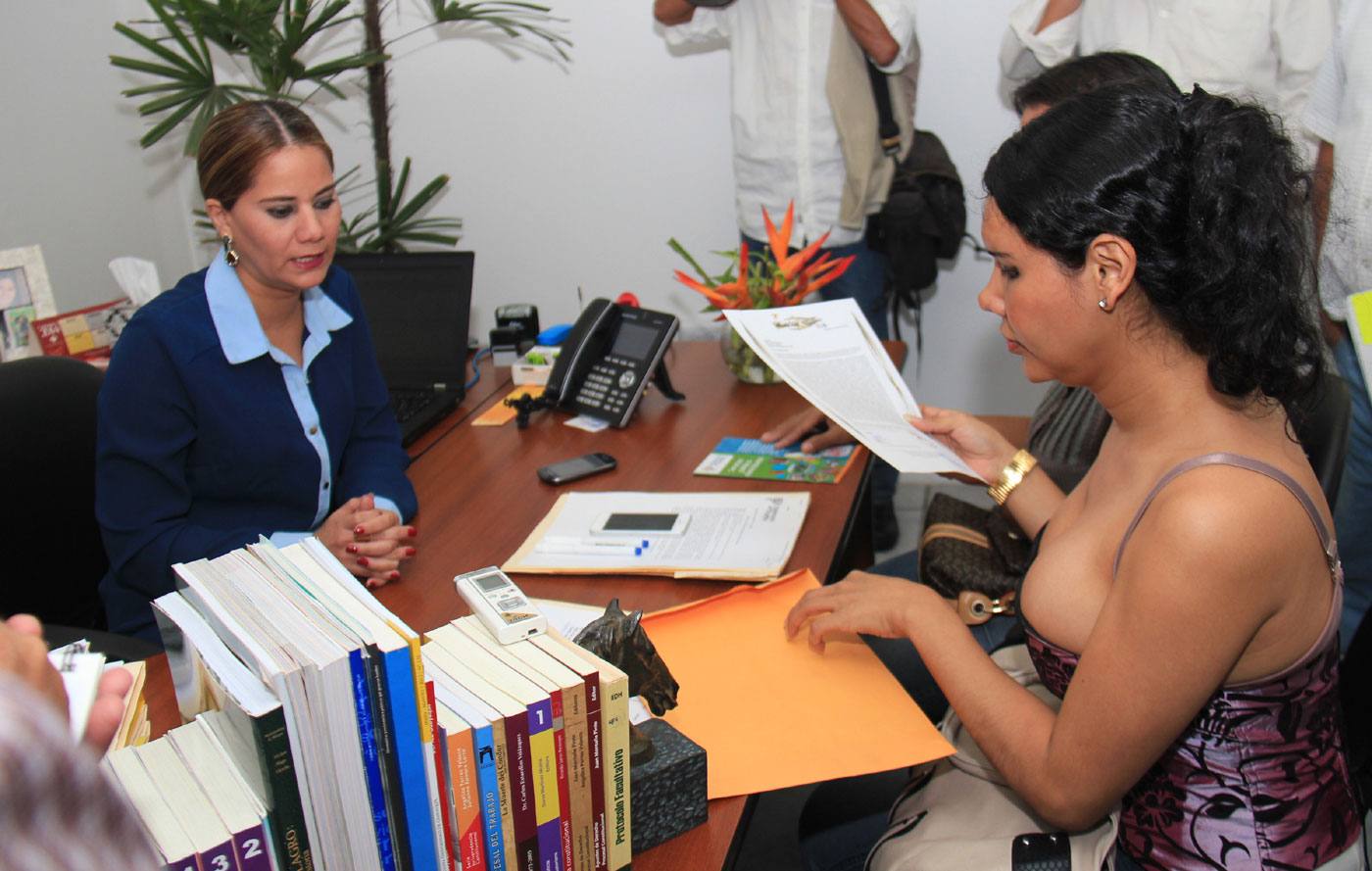
A specific complaint filed by Silueta X over an episode of La Pareja Feliz ended with an administrative decision holding Teleamazonas responsible for broadcasting discriminatory content based on sexual orientation and ordering a public apology to people of diverse sexual orientations. The network complied. The case was later recorded by the Inter-American Commission on Human Rights’ Office of the Special Rapporteur for Freedom of Expression in its 2014 Annual Report.
At the same time, the broader advocacy effort produced another result: the cast of Vivos opened dialogue with CORDICOM and expressed a willingness to change content. The history was therefore not only about sanctions. It was also about dialogue, media accountability and changing the terms of representation.
2013 · before the legal case
The campaign began with a simple challenge: “Make Me Laugh Intelligently”
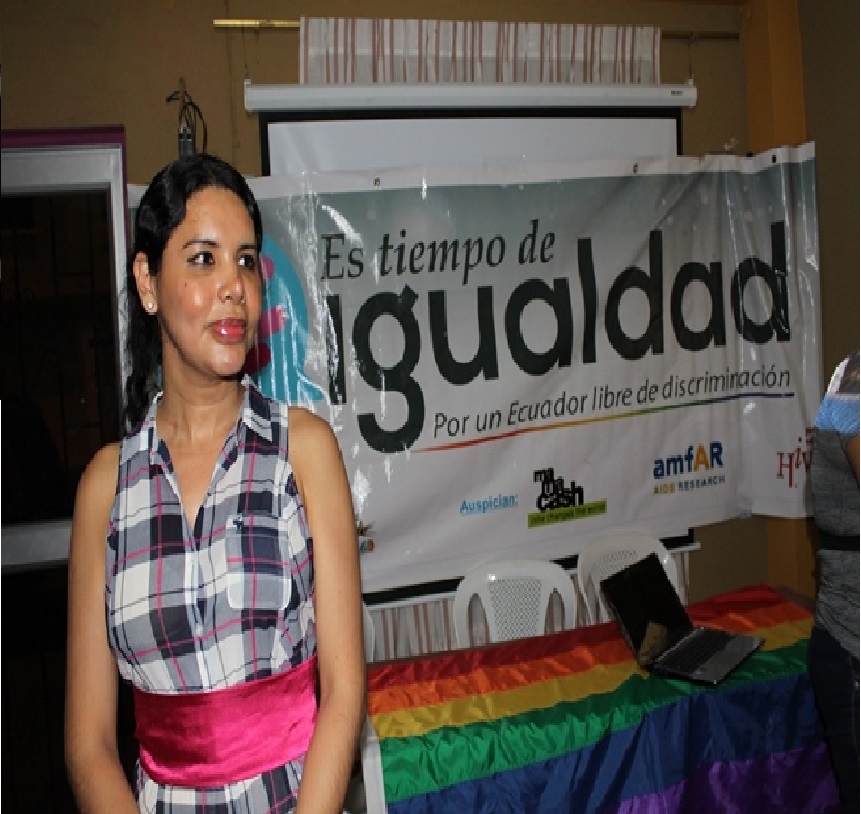
Silueta X’s archive places the origins of this line of advocacy in 2013, connected to the platform Tiempo de Igualdad. The argument was not that humor should disappear. It was that creative work could demand more from itself than repeating the same stereotypes.
The question
What exactly are we laughing at?
The campaign challenged the shortcut of making identity itself — being a woman, Indigenous, Afro-Ecuadorian, Montubio, gay or trans — sufficient reason for a character to be treated as ridiculous.
The proposition
More creativity, not less comedy
Diane Rodríguez publicly framed the initiative as a challenge to comedians and producers: build humor that was healthy, creative and innovative without making stigma and discrimination do the work of the punchline.
The frame
This was never only an LGBTQ+ issue
Silueta X explicitly connected the debate to stereotypes affecting women, Indigenous peoples, Afro-Ecuadorians, Montubios and other groups facing historic exclusion.
The core question
Visibility is not the same thing as dignified representation
In a national television interview in May 2014, Diane Rodríguez articulated a distinction that remains relevant to media advocacy today: the mere presence of an LGBTQ+ character does not automatically amount to positive or fair representation.
Afro-descendant communities
Visibility without racial coding
The advocacy argued that the presence of Afro-Ecuadorian characters could not be called “inclusion” when the roles repeatedly associated Blackness with criminality, subordination or socially devalued labor.
Women
Inequality can be written into the script
The coalition questioned characters and dialogue that normalized sexism, objectification and women’s subordination as recurring comedic devices.
LGBTQ+ and trans people
Sexual orientation is not a punchline
Silueta X challenged portrayals in which gay-coded or gender-nonconforming characters were built around sexualization, disgust, suspicion, ridicule or rejection — stereotypes with consequences beyond entertainment.
An important historical distinction
Silueta X did not begin by demanding that comedy shows be taken off the air
Stated objective
Improve content
In April 2014, Rodríguez said the complaints were not initially intended to eliminate Vivos, La Pareja Feliz or Mi Recinto, but to open a process for improving content and developing production standards that reduced discriminatory portrayals.
The counterargument
Freedom of expression
Actors, producers and critics argued that audiences could change the channel and that heavy-handed regulation threatened artistic expression. The tension between freedom of expression and non-discrimination ran through the entire case.
Silueta X’s response
Popularity does not settle a rights question
The organization argued that the number of people who enjoyed a character could not determine whether a broadcast violated rights. That question had to be examined through the legal framework and the evidence.


May–June 2014 · evidence gathering was part of the advocacy
To challenge a television program, Silueta X first had to obtain the material and examine it
Requesting copies
Silueta X requested complete program recordings
The strategy could not rely on memory or viral clips. Diane Rodríguez requested copies of Vivos and La Pareja Feliz so the organization could review specific expressions and build an evidence-based complaint.
June 5, 2014
Two USD 1,360 fines
SUPERCOM sanctioned Teleamazonas twice, USD 1,360 each time, for failing to deliver requested copies within the legal deadline. These procedural sanctions were directly connected to the requests made by Rodríguez/Silueta X.
May 30, 2014
“Being included does not mean we feel represented”
On Contacto Directo, Rodríguez emphasized that it would be the competent authority — not Silueta X acting alone — that would determine whether the content met the legal definition of discrimination. The organization’s role was to gather evidence and trigger the process.
June 27, 2014 · the specific complaint
Silueta X turned a television sketch into a documented legal file
The formal complaint filed by Asociación Silueta X focused on an episode of La Pareja Feliz broadcast on January 2, 2014, at approximately 11:18. The filing asked authorities to examine the program’s classification, broadcast time and, most importantly, scenes Silueta X argued were stereotypical and discriminatory on the basis of sexual orientation.
Scene 1
Male affection framed as disgust
The complaint described gestures of surprise, rejection and revulsion when two male characters embraced or showed affection, reinforced by sound effects designed to turn the suggestion of homosexuality into a comedic trigger.
Scene 2
The idea of “contamination” turned into a visual gag
The filing highlighted a sequence in which a character wiped his hand on his shirt after shaking hands with a man perceived as gay, while the production emphasized the gesture. Silueta X argued that the scene linked sexual orientation to rejection and contamination.
What Silueta X asked for
A formal discrimination assessment
The complaint did not stop at saying the sketch was offensive. It asked CORDICOM to apply the standards of Ecuador’s then-current Organic Law on Communication and determine whether the content legally met the elements of discrimination.
September 29, 2014 · administrative hearing
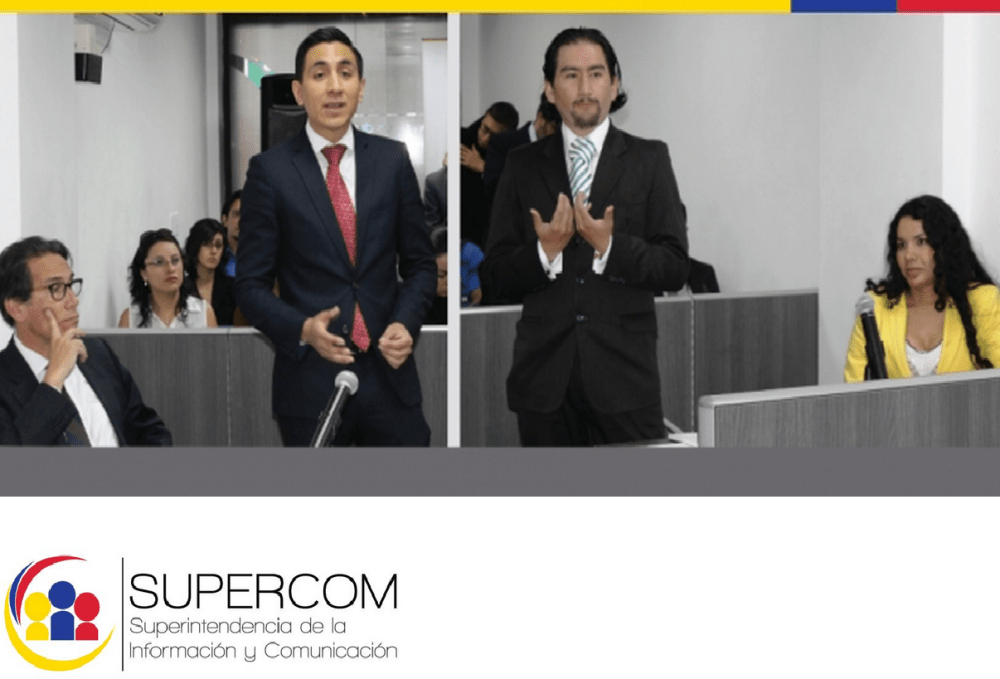
The dispute reached a formal hearing before SUPERCOM
Silueta X
A case about discriminatory messaging
Diane Rodríguez appeared with attorney Alejandro Burbano Piedra. The complainant side presented the video and CORDICOM’s technical resolution to argue that the scenes reproduced rejection and stigmatization based on sexual orientation.
Teleamazonas
Comedy, artistic creation and freedom of expression
The network’s defense argued that the program was comedy and that content could be vulgar, offensive or unpleasant without automatically becoming legally discriminatory. It also objected to state authorities evaluating artistic expression.
The significance of the case does not require erasing the network’s freedom-of-expression argument. The decision was consequential precisely because the authority had to decide where protected comedic expression ended and, under the law then in force, responsibility for discriminatory content began.
October 6–8, 2014 · the administrative ruling
SUPERCOM held Teleamazonas responsible for discriminatory content based on sexual orientation
The decision found the network responsible for broadcasting the January 2 episode of La Pareja Feliz. The analysis described expressions of discomfort, repulsion and derogatory messaging capable of reinforcing stereotypes and social rejection of people of different sexual orientations.
The remedy required the network’s director to broadcast a public apology in the same program space within the established period and to keep the apology on the network’s website homepage for at least seven days.
This is the outcome directly attributable to Asociación Silueta X’s specific complaint: a filing initiated by the organization produced an administrative finding of responsibility and a public remedy addressed to the affected community.
October 2014 · public remedy
Teleamazonas issued the ordered public apology
The network published and broadcast an apology to people of diverse sexual orientations in compliance with the ruling. The case therefore moved from a civil-society complaint to a public act of institutional acknowledgment.
The case entered the international record
The story was covered in English by EcuadorTimes and circulated beyond Ecuador. More significantly, the 2014 Annual Report of the Inter-American Commission on Human Rights’ Office of the Special Rapporteur for Freedom of Expression recorded both the apology order arising from the complaint by the president of Silueta X and the network’s subsequent public response.
The Inter-American report discussed the episode inside a broader, critical review of media regulation in Ecuador. That dual lens matters: the case was both an anti-discrimination milestone and part of a regional debate over state regulation and freedom of expression.
A crucial historical distinction
The approximately USD 115,000 fine was real — but it came from a different proceeding
Over time, the different proceedings involving La Pareja Feliz became blended together in public memory. Recovering Silueta X’s achievement accurately requires separating them.
Silueta X proceeding
Sexual-orientation discrimination → public apology
The June 27 complaint over the January 2 episode produced the October ruling finding responsibility and ordering a public apology. The two earlier USD 1,360 fines for delayed or incomplete delivery of requested recordings were also directly connected to Rodríguez’s evidence requests.
Second proceeding
Five episodes → 5% revenue fine
On October 31, SUPERCOM imposed another sanction concerning five episodes: a fine equal to 5% of the network’s average revenue for the previous three months, reported at approximately USD 115,000, together with another apology. That sanction arose from a separate complaint filed by Yina del Pilar Quintana Zurita from what was then the National Council for Gender Equality.
Silueta X played a documented role in opening and sustaining the cycle of public and regulatory scrutiny, but it would be inaccurate to attribute the USD 115,000 fine to its complaint. November reporting linked the eventual removal of La Pareja Feliz to the cumulative effect of complaints and sanctions. Silueta X’s contribution was to open one of the pathways that demonstrated institutionally that comedic content could be examined under the right to non-discrimination.
November 2014 · a television industry in transition
La Pareja Feliz left Ecuadorian television after the cycle of complaints and sanctions
In November, national media and Fundamedios reported that the program would no longer air in Ecuador. David Reinoso connected the decision to regulatory sanctions and the risk of future fines. The program’s removal followed a broader regulatory environment involving separate proceedings rather than a single ruling.
Before the series ended, Silueta X had already achieved three verifiable outcomes: it helped force a national conversation, ensured the content was examined institutionally, and obtained a favorable ruling with a public remedy. That sequence is sufficient to understand the case as a historic media-accountability achievement against discrimination.
Why this case still matters
The question moved from “does the joke offend you?” to “what does the joke normalize?”
From individual reaction to structural impact
One person being unoffended does not settle the pattern
Rights analysis does not depend on every member of a community reacting identically to a joke. The institutional question in this case was whether a message reproduced exclusion, stigma or discrimination under the law then in force.
From ratings to citizenship
“Change the channel” does not erase cultural influence
The campaign argued that mass television does not merely reflect prejudice. It also teaches audiences which groups may be repeatedly framed as objects of ridicule, suspicion or rejection.
From punishment to transformation
The strongest outcome was changed practice
The Vivos process showed that advocacy could produce dialogue and willingness to change; the La Pareja Feliz proceeding showed that when dialogue was insufficient, there was also a route for institutional accountability.
Source archive
Documents that reconstruct the case
Memory, archive and precision
Historical memory becomes stronger when it separates evidence from recollection
This reconstruction prioritizes contemporaneous 2014 documents, news reports, administrative decisions, the complaint published by Silueta X and human-rights sources. Personal memories for which no public documentary support has yet been located are not presented as established fact.
Public documents: regulatory decisions and official acts retain their public nature and institutional provenance. Press: rights in third-party articles and images remain with their respective rights holders.
Silueta X archive: the selection, recovery, chronology and contextualization form part of the organization’s historical-memory work.
From historical memory to action
Facing discrimination in media, platforms or public spaces?
The institutions, procedures and legal rules described on this page belong to Ecuador’s 2014 regulatory framework and should not be treated as current legal instructions. Contemporary cases require current-law verification and careful documentation.
Legal support
Consultorio Jurídico X
The Consultorio Jurídico X de la Asociación Silueta X, miembro de la Federación Ecuatoriana de Organizaciones LGBT receives cases and provides guidance on possible rights violations.
Contact Consultorio Jurídico X →Archive contribution
Help complete the record
If you preserve original clippings, photographs, videos, decisions or campaign materials, you can help strengthen this documentary history.
Contact Silueta X →
