

Women-centered approach
Surviving violence should never become a permanent identity.
Women X is grounded in a survivor-centered, trauma-informed, intersectional and autonomy-oriented approach. Immediate safety may come first; later, a woman may need mental-health support, documentation, housing, childcare, justice, employment or income. The program is designed to connect those responses around the woman rather than requiring her to retell her story to every service provider.
Women in all their diversity
There is no single way to be a woman — and no single experience of vulnerability
The program recognizes that violence, poverty, care responsibilities, displacement, disability, ethnicity, geography, sexual orientation, age and migration status can intersect and create different barriers.
Women X is primarily oriented toward cisgender women and other women who need these services. Trans, lesbian, bisexual and queer women remain part of Silueta X’s broader mission and can also access the organization’s specialized units.
Documented track record
From feminist advocacy and family rights to direct wellbeing and autonomy services
Historical documentation concerning cisgender women is more dispersed in Silueta X’s early years than its trans-rights record. This timeline therefore distinguishes advocacy and public action from direct services that are explicitly documented in more recent years.
2012 · gender and citizenship
Creating space to discuss what it means to be a woman
Around International Women’s Day, Silueta X promoted public spaces for reflection on womanhood, gender, stereotypes and discrimination, bringing together voices from civil society, academia and politics.
2014–2015 · feminist action
Gender-based violence in public space
Silueta X’s archive documents Ecuador’s SlutWalk (Marcha de las Putas) as feminist action against sexual and gender-based violence, abuse, objectification, exclusion and the structures used to justify violence against women and feminized bodies.
2016 · families
Single mothers and single-parent households
The Familias Diversas campaign explicitly recognized single mothers and single-parent households, often headed by women, within a broader agenda of recognition, rights and family protection.
2023 · monitoring femi(ni)cides
A national alliance that includes transfemicides
Since 2023, Asociación Silueta X has been part of the National Alliance for Monitoring Femi(ni)cides in Ecuador, led by Fundación ALDEA. Through the Runa Sipiy Observatory, Silueta X contributes specialist expertise in monitoring, analyzing and documenting transfemicides, strengthening the national analysis of feminicidal violence and contributing to Alliance reports. Technical coordination on transfemicide data had already been developing since 2022.
2024 · mental health
Explicit inclusion of low-income cisgender women
Centro Psico X records show that in 2024 psychological care was expanded to cisgender women in lower socioeconomic quintiles, explicitly bringing this population into the service model.
2024 · intersectionality
Gender, disability and mental health
At “Voces Unidas,” organized by the Neurosciences Institute of the Junta de Beneficencia, Silueta X contributed proposals addressing the intersection of gender, disability, mental health, stigma and human rights in efforts to eliminate violence.
2025 · services for survivors
Cisgender women survivors within Centro Psico X
The 2025 institutional report records a significant increase in consultations from cisgender women affected by gender-based violence, reported there as 18%, and expands free services to women experiencing violence, migrants, refugees and people living in extreme poverty.
2024–2026 · conflict and protection
National insecurity also has gendered consequences
Silueta X and its networks have documented risks arising from Ecuador’s internal armed-conflict context and broader security crisis. The organization’s current mission explicitly identifies women displaced by this context as a priority population.
2026 · markets and livelihoods
Women Entrepreneurs X
The Mercadito del Dólar was explicitly promoted for diverse women, including migrants, Afro-descendant women, older women, survivors of violence and women displaced by the internal armed conflict, creating a local market-access space.
2026 · productive skills
Baking, resilience and autonomy
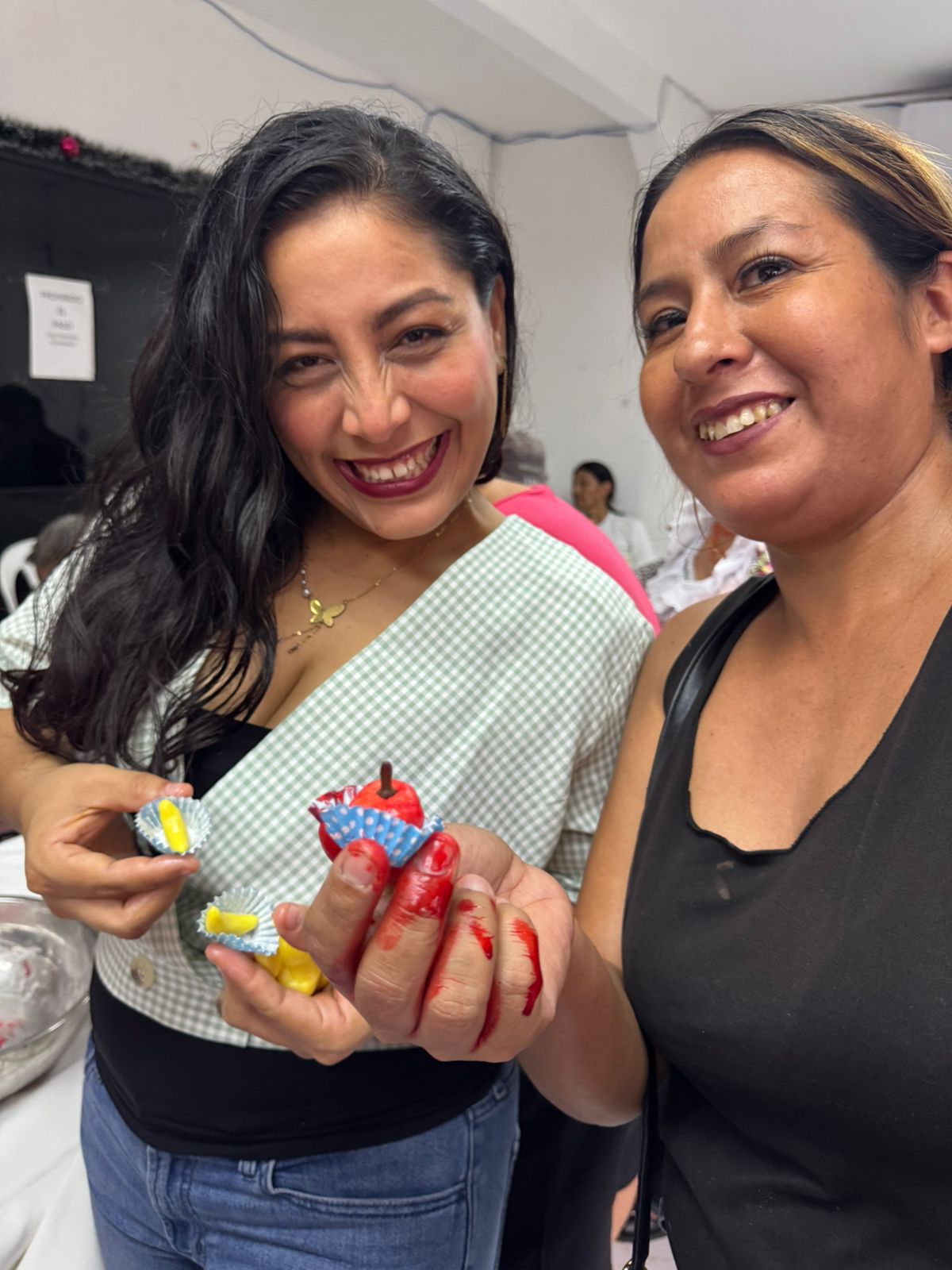
A technical baking and sugar-modeling workshop explicitly included Indigenous and rural women and survivors of gender-based violence, linking productive skills with economic independence.

Gender-based violence · survivor-centered response
Safety first. Decisions next. No blame, no coercion.
The response is organized around each woman’s needs and choices, without making a criminal complaint a condition for receiving support.

Internal displacement · human mobility · protection
Leaving can save a life. Starting again takes more than reaching a new place.
Silueta X’s current mission explicitly identifies women displaced by the internal armed conflict as a priority population. Women X organizes a recovery pathway linking protection, wellbeing and livelihoods.
Protection
Risk assessment and safe referral
Initial guidance, risk identification, connection to specialized protection and support to avoid unnecessary exposure of a woman’s location or sensitive information.
Recovery
Mental health and rebuilding support networks
Psychosocial support for loss, fear, disrupted networks, family separation, repeated displacement and stress caused by insecurity.
Livelihoods
Rebuilding income
Training, entrepreneurship, market access and referral to employment opportunities for women whose economic activity has been disrupted by violence or displacement.
In 2025, Ecuador’s Ombudsman’s Office, with UNHCR support, published a baseline study on the impact of violence and internal displacement in Ecuador between 2022 and 2024. Women X aligns with the need to connect protection, solutions, mental health and economic recovery while distinguishing internal displacement from international migration.
Economic autonomy · livelihoods · recovery
Economic independence alone does not guarantee a life free from violence. But having options changes a woman’s room to decide.

Care economy · single mothers · women-led households
Care is work, even when it never appears on a payslip
Women X reframes the women commonly described as “homemakers” through a rights-based lens: women engaged in unpaid domestic and care work. Cooking, cleaning, accompanying family members, raising children and caring for older people, people who are ill or people with disabilities sustains life, while often limiting time available for training, employment, rest and participation.
Time
Training that works around care responsibilities
Flexible, virtual or concentrated formats that reduce exclusion for women who cannot participate during conventional schedules.
Family
Single mothers and single-parent households
Guidance, wellbeing, economic autonomy and connection to services, recognizing that income, parenting and care responsibilities may be concentrated in one woman.
Autonomy
Financial and digital skills
Tools for budgeting, saving, payments, marketing, digital safety and gradual access to economic opportunities.
Institutional precedent: the 2016 Familias Diversas campaign explicitly recognized single-mother families and single-parent households. Women X turns that social recognition into a wellbeing, care and autonomy pathway for women sustaining households.

Women X program architecture
Twelve pathways from emergency response to recovery, and from recovery to autonomy
01 · Violence
GBV prevention and response
Information, initial risk assessment, safety, referral and survivor-centered response to gender-based violence.
02 · Wellbeing
Mental health and MHPSS
Psychological care, crisis response, trauma support, grief support, self-esteem, support groups and psychoeducational workshops.
03 · Justice
Legal empowerment
Rights, protection measures, reporting options, accompaniment and referral to Consultorio Jurídico X.
04 · Protection
Internal displacement
Protection, referrals, wellbeing, documentation, safety and livelihood recovery for women displaced by violence.
05 · Mobility
Migrant and refugee women
Guidance, protection, mental health, networks and inclusion pathways for women on the move.
06 · Income
Economic autonomy
Training, entrepreneurship, employability, market access, financial education and coordination with Economic Inclusion X.
07 · Care
Domestic and care work
Recognition of care burdens, time poverty, wellbeing, skills and flexible ways to access opportunities.
08 · Families
Single mothers and women heading households
Wellbeing, family protection, support networks, economic autonomy and referrals based on the needs of women and their dependents.
09 · Inclusion
Disability, ethnicity and territory
Accessible and culturally responsive design for Indigenous, rural and Afro-descendant women, women with disabilities and neurodivergent women.
10 · Technology
Digital inclusion and safety
Digital literacy, privacy, technology-facilitated violence, productivity tools and safe access to remote services.
11 · Leadership
Women’s participation and networks
Spaces for voice, community networks, rights education, co-design and women’s leadership.
12 · Evidence
Data for better responses
Research, monitoring, evaluation and disaggregated data with confidentiality safeguards and women’s participation in interpreting findings. This includes Runa Sipiy’s specialist contribution to national transfemicide monitoring and its coordination with the National Alliance for Monitoring Femi(ni)cides.
One entry point, multiple capabilities
Women X reconnects what violence so often fragments
The program does not attempt to reproduce every specialization in a single office. It functions as an access and coordination pathway into Silueta X’s existing capacities.
Alignment with international cooperation frameworks
Gender-based violence + economic autonomy + care + Women, Peace and Security
Women X aligns with current international priorities without treating them as decorative labels: protection from violence, economic autonomy, recognition of care work, displacement and women’s participation in peace and security contexts.
These references indicate conceptual and programmatic alignment only. They do not imply funding, accreditation or an institutional relationship with UN Women, UNHCR or Ecuador’s Ombudsman’s Office.
Monitoring, Evaluation & Learning
Success is not measured only by how many women arrive, but by what changes afterward
Indicators should track safety, access, recovery and autonomy without creating databases that could put survivors or displaced women at risk.
safety plans, referrals and perceived safety.
access to care, continuity and perceived support.
legal guidance, protection measures and referred cases.
displaced women connected to relevant pathways.
skills, businesses, sales and opportunities.
self-reported ability to make decisions and access resources.
time-related barriers identified and access adaptations made.
women co-designing, leading or evaluating actions.
Technical and territorial cooperation
Protection works better when a woman does not have to choose between health, justice and income
Women X is designed to collaborate with women’s organizations, protection services, local governments, universities, public-health institutions, the private sector, community networks and international cooperation partners around integrated and measurable responses.
GBV and MHPSS
Protection and recovery
Care pathways, mental health, prevention, referral and barrier reduction for survivors.
Livelihoods
Economic recovery
Training, market access, entrepreneurship, employability and models compatible with care responsibilities.
Humanitarian protection
Displacement and mobility
Pathways for displaced, migrant and refugee women with a gender-responsive approach, confidentiality and recovery support.
Archive and traceability
A track record that can be traced
Historical rigor
Do not turn today’s mission into a history that is not documented
The earliest records identified concerning cisgender women relate mainly to feminist advocacy, family diversity and intersectional action. Direct services explicitly documented for low-income cisgender women and survivors of violence become much clearer from 2024 onward. Women X acknowledges that evolution without artificially backdating services that are not supported by evidence.
Language: “survivor” is preferred when discussing recovery and autonomy, even when legal categories or historical documents use “victim.”
Confidentiality: photographs and cases involving violence should never be used sensationally. The program prioritizes images of participation, skills and agency and avoids turning individual suffering into a promotional asset.

