
Strategic Litigation · Trans Rights · Ecuador
He was hired to teach the State not to discriminate.
Zack Elías ended up taking the system surrounding that same inclusion project to constitutional court.
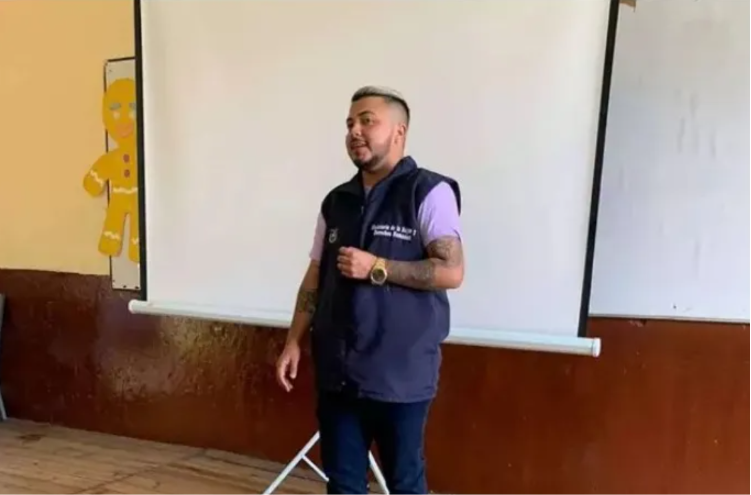
In 2023, Zackary Oriel Elías Morales — a trans man, human-rights advocate and current Director of Asociación Silueta X — worked as a trainer in a national project linked to Ecuador’s then Ministry of Women and Human Rights.
His job was to teach public officials how to prevent violence and discrimination based on sexual orientation, gender identity and gender expression. Inside that very project, he reported discriminatory treatment, unsafe accommodation, workplace hostility, economic irregularities and institutional silence.
In November 2023, constitutional justice ruled in his favor.
Why this case matters to funders
Policies can promise inclusion. Independent civil society tests whether inclusion is real.
Zack’s case reveals the gap that donors frequently seek to close: the distance between laws, public programs and what marginalized people actually experience when institutions are not independently monitored.
The central contradiction
The project was teaching the State how to understand gender identity
At the same time Zack was training public officials to prevent violence and discrimination against LGBT+ people, he began reporting that the conditions surrounding his own work failed to adequately protect his identity, privacy, security and economic rights.
What the project taught
Gender identity
Public institutions were being trained to understand that respecting a trans person’s identity also requires protecting dignity, privacy, bodily autonomy and personal safety.
What Zack reported experiencing
Discrimination and hostility
Zack reported conflict surrounding his trans identity, accommodation during work travel, economic complaints and an increasingly hostile working environment.
The State’s response
Silence
When Zack formally placed the allegations before the Ministry, the response was not timely. That institutional failure later became one of the constitutional violations recognized by the court.
Public money was being used to teach officials how to prevent gender-identity discrimination while a trans trainer working inside the same initiative had to seek constitutional protection to have his complaints meaningfully addressed.
Recognition ≠ exposure
Recognizing Zack as a man did not justify ignoring his privacy and safety
Accommodation during work travel
News coverage of the case documented Zack’s objection to being required to share rooms with men during work-related travel.
In his view, correctly recognizing him as a man could not be used as a mechanical excuse to disregard the specific questions of privacy, bodily exposure and safety that can affect a trans person.
Equality is not mechanical
Equal treatment does not mean applying the same rule without context. A measure that appears neutral can create disproportionate risk when it ignores the circumstances of a historically marginalized person.
Zack said he requested safer accommodation. According to his account and Silueta X’s institutional record, the dispute became part of the deterioration of his working environment.
The economic irregularity Zack reported
USD 1,200 → USD 500 → USD 700
This sequence is not a later reconstruction by Silueta X. It appears among the allegations reproduced in the constitutional judgment itself.
The alleged agreement
Zack’s claim states that the contractor initially established monthly compensation of USD 1,200 and that the first payment was made for that amount.
The requested transfer
After the first payment, Zack stated that he was asked to transfer USD 500 to another account, allegedly to cover payments for people performing logistical duties.
The later payments
According to the case record, Zack later alleged that he began receiving USD 700 directly despite the USD 1,200 amount he said had originally been agreed.
What Silueta X means by a “kickback”
In Ecuador, the slang term vacuna can be used to describe arrangements in which a worker is allegedly required to surrender part of the money attached to an employment or contracting opportunity.
Silueta X considers the mechanism described by Zack comparable to an alleged kickback arrangement. The constitutional case was not, however, a criminal corruption, extortion or embezzlement proceeding, and the judgment did not establish that such a crime had occurred. What the record does establish is that Zack included the disputed payments and transfer among the facts brought before the court.
Speaking up had consequences
First he raised concerns inside the project. Then he went to the Ministry. Finally, he went to court.
2023
Concerns begin
Zack begins working as a trainer on May 3. As the project progresses, disputes emerge around gender identity, accommodation, treatment and payments.
The financial dispute deepens
According to the claim, the direct payments fall to USD 700. Zack continues raising concerns and says that officials connected with the diversity program were also made aware of the problems.
28
The complaint reaches the Ministry formally
Zack formally reports the situation in writing. The later constitutional action would identify the lack of an adequate response to this communication as part of the rights violation.
24
Constitutional protection action
After failing to obtain an effective response, Zack files constitutional case 17371-2023-02438 before the Labor Judicial Unit in Iñaquito, Quito, acting in its constitutional jurisdiction.
20
The court grants protection
The favorable decision comes on November 20 — Transgender Day of Remembrance. The written judgment is formally notified three days later.
What the court found
Two respondents. Two distinct constitutional violations.
Contractor
Equality and non-discrimination
The court found that Zack’s constitutional right to equality and non-discrimination had been violated in connection with the conduct attributed to the contractor responsible for implementing the project.
Ministry of Women and Human Rights
Right of petition
The State institution was found responsible for violating Zack’s constitutional right of petition by failing to adequately address the complaint he had formally submitted.
Why precise attribution matters
The judgment should not be simplified into the claim that “the Ministry was convicted of transphobia.” The legal findings were more precise: discrimination was attributed to the contractor, while the Ministry itself was held constitutionally responsible for failing to properly respond to Zack’s complaint.
Remedy
Winning the case was only the beginning
Public apology
The Ministry was required to publicly acknowledge its violation of Zack’s right of petition. Compliance was delayed and required further advocacy.
Psychological support
The ruling also required support addressing the psychological impact associated with Zack’s experience.
Judicial supervision
The case continued after judgment through enforcement proceedings, objections regarding the form of reparation and appeals.
The remedy that remained incomplete
How could psychological recovery depend on the same institution Zack no longer trusted?
Zack identified an obvious problem: the Ministry whose omission had been recognized by the court — and within whose project the underlying events had occurred — was also expected to provide the psychological support ordered as part of the remedy.
February 5, 2024
Zack requests an independent provider
The judicial record contains Zack’s formal request that psychological rehabilitation be provided by an institution other than the Ministry of Women and Human Rights.
Violeta Center
The Ministry uses its own service
The institution reported that it had activated its own protection services and Violeta Centers to provide the support ordered by the court.
Clinical report
The assigned professional records distress
The clinical psychologist assigned through the Ministry’s Violeta Center documented Zack’s discomfort and distress during the attempted support process.
Professional recommendation
Refer him elsewhere
The psychologist herself recommended referral to another public institution where Zack could feel safe and emotionally stable.
Zack did not reject psychological support
He challenged the idea that the remedy should be administered by the same institutional structure he had been forced to confront. His concern was formally raised with the court and was ultimately reinforced by the recommendation of the Ministry’s own assigned professional.
In the judicial communications and institutional records reviewed for this reconstruction, we found no later confirmation that the recommended external referral was completed. Zack and Asociación Silueta X therefore regard the psychological remedy as incomplete.
Winning was not enough
Civil society also had to push for the judgment to be implemented
The written judgment was issued in November 2023, yet by early January 2024 advocates were still reporting that the required public apology had not appeared.
On January 3, a Silueta X statement documenting the failure to comply was distributed internationally through Europa Press.
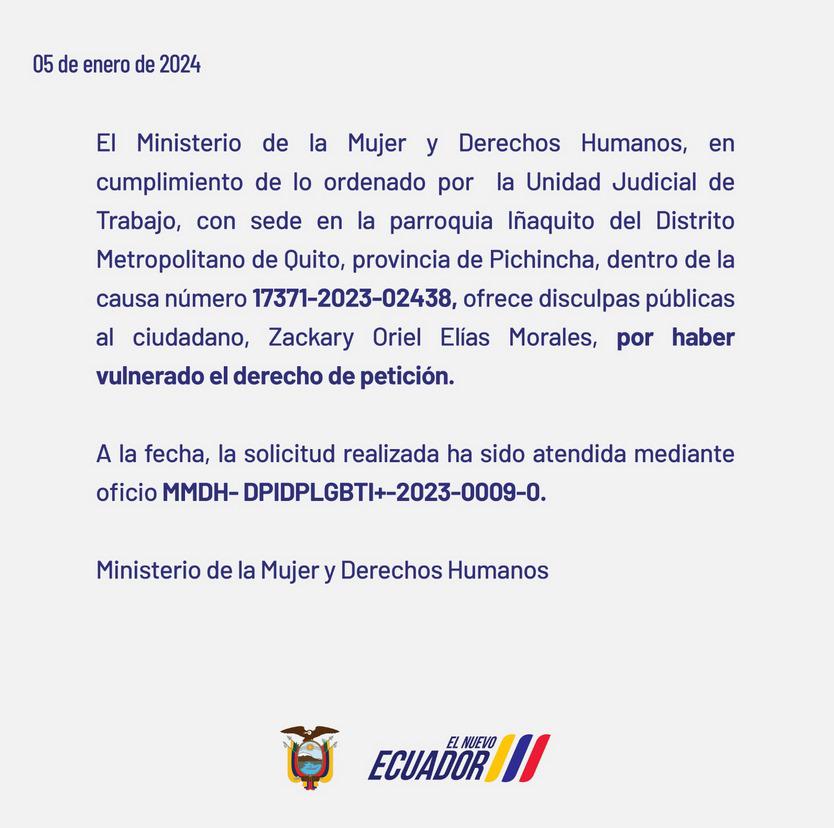
On January 5, 2024, the Ministry finally published the court-ordered apology.
State acknowledgment
The Ministry itself was required to publicly acknowledge that it had violated Zackary Oriel Elías Morales’s constitutional right of petition.
An uncomfortable but necessary conversation
Transphobia can also exist inside LGBT+ spaces
Belonging to one historically marginalized group does not automatically prevent someone from reproducing prejudice against another.
Intra-community prejudice
Zack’s case raises the difficult question of whether organizations and projects operating under an LGBT+ umbrella can still reproduce hierarchy, ignorance or stigma toward trans men, non-binary people or other identities.
Diversity does not automatically equal expertise
Being lesbian, gay, bisexual or trans does not automatically provide knowledge of every other sexual orientation, gender identity or gender expression.
Workplace bullying and harassment alleged
What happens when challenging discrimination also challenges power?
Zack and Asociación Silueta X describe the overall experience as harassment, workplace bullying and a hostile environment. The record documents escalating complaints, a formal petition, conflict surrounding his working conditions and his eventual removal from the project.
For legal accuracy, this page distinguishes that broader characterization from the court’s specific findings: equality and non-discrimination in relation to the contractor, and the right of petition in relation to the Ministry.
The litigation continued
The respondents appealed
Both the public institution and the contractor challenged the first-instance decision. In 2024, the Specialized Family, Children and Adolescents Chamber of the Provincial Court of Pichincha considered the case on appeal.
Silueta X’s institutional archive preserves records from both stages. This page focuses on the constitutional violations and remedies that can be reconstructed directly from the material reviewed.
Media reach
The case moved from the courtroom into the public debate
Coverage documented the constitutional victory, the discrimination allegations and the later struggle to secure compliance with the judgment.
What the constitutional ruling did not fully resolve
The outstanding economic dispute
Zack’s claim incorporated allegations of unpaid amounts and differences between the compensation he said had been agreed and what he ultimately received. The constitutional case, however, focused on rights violations rather than operating as an ordinary contractual payment proceeding or criminal investigation into the USD 500 transfer.
Zack and Silueta X maintain that financial obligations related to his work have not been fully resolved. This page records that as an outstanding claim by the affected party rather than as a debt quantified through the constitutional judgment.
Institutional restructuring
From Ministry to Vice Ministry
The 2023 case concerned the then Ministry of Women and Human Rights. Following later restructuring of Ecuador’s executive branch, this institutional area ceased operating as an independent ministry.
Current institutional structure
Vice Ministry of Women and Human RightsThe corresponding institutional structure now operates within Ecuador’s Ministry of Government.
A rights and accountability achievement
Why this case matters far beyond one person
The role of Silueta X
Zack was the claimant. Silueta X helped document, amplify and monitor the case.
Claimant
The constitutional action was filed by Zackary Oriel Elías Morales in his own right.
Legal and human-rights support
Diane Rodríguez and other human-rights actors supported the case through legal argument, advocacy and public visibility.
Monitoring implementation
Silueta X and allied organizations documented the ruling, reported delays in compliance and maintained pressure until the public apology was issued.
Sources and evidence
The case can be reconstructed from the record
This page distinguishes between facts established by the courts, allegations included by Zack in his claim, independent media reporting and institutional assessments by Asociación Silueta X.

