

The historical argument of this page
Marriage equality in 2019 was a collective achievement built through multiple legal routes, people and organizations. This page documents one of those routes in particular depth: making Article 68’s de facto union enforceable, turning it into an accessible administrative registration, placing it on identity documents, later consolidating it as a civil status, and publicly normalizing the legal existence of same-sex and trans couples.
It is historically defensible to describe that process as a documented foundation on the road toward marriage equality. Claiming that any single campaign “created” marriage equality by itself would erase other struggles and would not be historically rigorous.
Terminology note: Ecuadorian law uses the term unión de hecho, which may be translated as “de facto union.” The historical campaign used the political framing Unión Civil Igualitaria, rendered here as “Equal Civil Union” or “civil union” when referring to the campaign and its public advocacy. Both expressions are preserved where legally or historically appropriate.
The right was written down, but it did not work equally for every couple
2008–2013: turning a constitutional promise into a public problem
2008 · Constitution
Article 68 said “two persons”
The Constitution recognized that a stable and monogamous union between two persons free of a marriage bond could generate the same rights and obligations as families constituted through marriage, subject to the constitutional exception concerning adoption. The wording opened a legal door for same-sex couples, but the existence of the constitutional provision did not by itself guarantee a simple, uniform administrative registration process.
2010–2012 · The judicial precedent
D.A.M. and M.B.G.S. took the Civil Registry’s refusal to court
In 2010, D.A.M. and M.B.G.S. attempted to register their de facto union. Their request was denied. During the same period, the Civil Registry issued Resolution 0277, which prevented de facto unions from being entered into the electronic registry and identity cards as a civil status.
In 2012, the Third Chamber of Criminal Guarantees of Pichincha accepted their action and ordered the registration. Years later, in Judgment 603-12-JP/19, Ecuador’s Constitutional Court confirmed that denying registration to same-sex couples is discriminatory. This precedent belongs to the claimants who brought the case and must be recognized as such. Silueta X documented it and later incorporated it into its research and advocacy.
2013 · Silueta X research
Only 5 of 42 notary offices in Guayaquil appeared accessible to same-sex couples without obstacles
Asociación Silueta X’s Report on Access to Justice and Human Rights of TILGB People incorporated the earlier judicial precedent and a field review of notary offices in Guayaquil. The campaign reported that only five of 42 offices processed same-sex de facto unions without difficulties.
The problem was no longer abstract: a constitutional right meant little if couples still encountered closed doors when they tried to exercise it.

December 13, 2013 · Dialogue with the Executive Branch
When an administrative rights gap reached the presidential table
Silueta X’s archive documents that on December 13, 2013, GLBTI representatives met with then-President Rafael Correa. Among the issues brought before the Executive were Civil Registry barriers, de facto unions and the gender-identity agenda.


Why name Rafael Correa in this history?
Because historical accuracy requires it. He was the sitting president during the 2013 and 2014 meetings and publicly stated that same-sex couples had a constitutional right to register their de facto unions. Naming him does not imply endorsement of his political project. It is equally important to record that Correa opposed same-sex marriage at that time. The 2014 advance concerned de facto unions, not marriage equality.
August 18–23, 2014 · A decisive week
From political dialogue to a resolution that changed civil registration
Core historical document
Resolution 0174: the administrative instrument that broke the 2010 barrier
Official Gazette No. 374, published in November 2014, formally included Resolution 0174-DIGERCIC-DNAJ-2014, which repealed Resolution 0277 of 2010.


A legal distinction the historical record should preserve
Activist discourse and several 2014 headlines referred to de facto union as a “civil status.” Resolution 0174, however, initially operated through a special registry and as supplementary civil-status information. Precisely because this protection remained administratively fragile, the campaign later called for reform of the Civil Code.
Legal consolidation arrived in 2015: the Civil Code Reform Law expressly converted the de facto union into a civil status. That sequence — administrative resolution first, legislative reform second — is a fundamental part of the achievement.
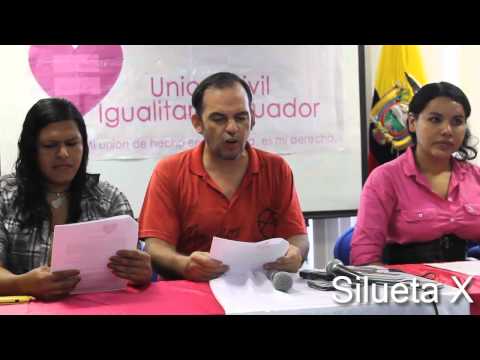
September 2, 2014 · The national campaign is launched
“My de facto union on my ID is my right”
The Unión Civil Igualitaria campaign was launched simultaneously in Quito, Guayaquil, Cuenca and Machala. Its historical archive identifies it as an initiative of Asociación Silueta X and the Observatorio GLBTI del Ecuador, supported by approximately fifteen LGBTI and allied organizations.

Documented authorship and leadership
A coalition led by Asociación Silueta X
The campaign’s own archive identifies Diane Rodríguez of Asociación Silueta X among its directors and attributes the initiative to Silueta X and the Observatorio GLBTI del Ecuador. Another historical campaign page credits Isaías/Carlos Álvarez of the Observatory as part of the original idea.
The most rigorous way to preserve credit is to recognize the full network: Silueta X played a central role in leadership, research, government dialogue, communications and mobilization within a coalition that made it possible to take the campaign to several cities.
A campaign in four cities
Changing a resolution was not enough: people had to know they could use it


September 15, 2014 · The right became visible
From the resolution to the Civil Registry counter
Registrations began on September 15. The act carried legal force, but also cultural significance: trans, lesbian, gay and heterosexual couples passed through the same public offices and forced the system to translate a constitutional right into everyday documents.

Diane Rodríguez + Nicolás Guamanquispe
A trans couple became a public symbol of a newly usable right
El Telégrafo documented Diane and Nicolás as the first couple to complete the procedure in Guayaquil. Ecuavisa reported that, for the first time in Ecuador, trans and gay couples were able to register their unions in their identity documents. Washington Blade later described them as Ecuador’s first LGBT couple to legally register their relationship.
That the relationship ended years later does not alter the legal or historical meaning of the act. Civil rights do not depend on a relationship lasting forever. The administrative precedent occurred, was documented, and produced effects beyond the private lives of the people involved.
A debate that erased trans identity
“But you could already marry”: why that objection misses the point
At the time, some interpretations reduced Diane and Nicolás’s relationship to the sex markers contained in their documents and concluded that they could legally fit within the man–woman model of marriage. That argument overlooks the very political problem trans people were confronting: the State could classify a relationship in a way that failed to fully recognize the gender identities of the people in it.
Identity
We are not an outdated letter on an ID card
A trans couple does not stop being trans because a State database still uses a category that fails to accurately reflect the gender identity of one or both partners.
Rights strategy
Using the de facto union mechanism was also a political decision
The campaign sought to open and test a mechanism that same-sex and other diverse couples could actually use. Exercising it publicly helped demonstrate that Article 68 had to apply to real people rather than remain a constitutional formula on paper.
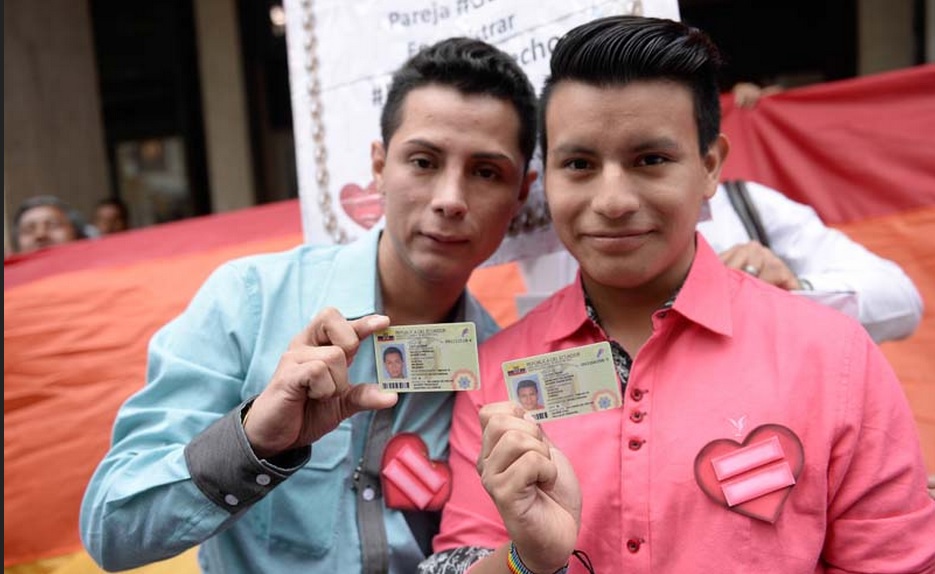


The story crossed borders
An Ecuadorian administrative reform became international news
The visibility of the first couples — especially Diane Rodríguez and Nicolás Guamanquispe as a trans couple — carried the story into Spanish-, English-, Portuguese-, French- and German-language media.
Two strategies coexisted
De facto union recognition and marriage equality were not the same strategy
A direct litigation route demanding civil marriage for same-sex couples also began in 2013. Activists publicly disagreed over priorities and strategies. A serious historical record does not need to turn those disagreements into a personal conflict.
Immediate-recognition route
Make Article 68 work
Unión Civil Igualitaria prioritized removing registration barriers, accompanying couples, engaging the Executive Branch and Civil Registry, obtaining a workable mechanism and then protecting it through legislative reform.
Marriage-equality route
Demand the same name for the right
Other activists and organizations pursued direct marriage litigation. That path continued, later drew strength from Inter-American Court Advisory Opinion OC-24/17, and culminated in the constitutional cases that transformed marriage law in 2019.
The de facto union campaign did not replace the struggle for marriage equality; it helped clear part of the legal, administrative and cultural ground on which that struggle continued to advance. Marriage equality did not suddenly appear in 2019. It followed years in which diverse couples forced the State to recognize, register and legally process their relationships.
2019 · The next threshold
From recognition of a partnership to the right to marry
On June 12, 2019, Ecuador’s Constitutional Court recognized same-sex marriage through cases 10-18-CN and 11-18-CN. The Court connected equality, non-discrimination and Inter-American Advisory Opinion OC-24/17.
Case 10-18-CN
The law could no longer exclude
The Court found unconstitutional the rules that prevented marriage because the two spouses were of the same sex and ordered the legal system to move toward equal treatment.
Case 11-18-CN
The Constitution could not be read to produce discrimination
The Court concluded that excluding same-sex couples from marriage resulted from a restrictive and discriminatory interpretation.
What the evidence supports
Giving Silueta X its documented place without replacing a collective history
Documented contribution
Silueta X’s role
It researched barriers in notary offices; incorporated judicial precedents into its report; participated in and helped articulate dialogue with the Executive Branch; led and communicated the Unión Civil Igualitaria campaign; mobilized simultaneous launches in several cities; accompanied early registrations; and later proposed legal reforms to consolidate de facto union as a civil status.
What must also remain visible
The process was broader
Article 68 came from the 2008 Constitution; D.A.M. and M.B.G.S. litigated the registration refusal; other organizations participated in Unión Civil Igualitaria; other activists took marriage directly to court; and the 2018–2019 constitutional cases were decisive for the final recognition of marriage equality.
Unión Civil Igualitaria was one of the processes that prepared the legal, administrative and social ground for broader family equality. Its historical value lies precisely in showing how a right develops in stages: first it is written, then litigated, regulated, exercised, consolidated in law, and finally turned into a platform for demanding the next right.
Memory, archive and intellectual property
Preserving history does not erase the authorship of each item
The recovery, selection, research, organization and contextualization of this archive form part of Asociación Silueta X’s historical-memory work. Bulk extraction, repackaging or commercial exploitation of this compilation is not authorized without permission.
Public documents: resolutions, judgments and official acts retain their public nature and institutional provenance. Third-party press: rights in news articles and press photographs remain with their respective rights holders.
Campaign archive: photographs and materials hosted in historical Unión Civil Igualitaria and Silueta X repositories are presented for memory, research and documentation purposes.
The right remains in force
De facto union or marriage? Today, the choice belongs to the couple.
Marriage equality did not eliminate de facto union. For some couples, a de facto union remains the legal figure that best fits their life plans. Ecuador’s Civil Registry currently continues to offer de facto union certificates among its electronic services.
I want to formalize a de facto union
Review your current legal situation
Requirements, fees and procedures from 2014 should not be used as current instructions. Personal circumstances, nationality, previous civil status and documentation can affect the process.
Ask Consultorio Jurídico X →I want to marry
Civil marriage is now equal
Since 2019, the sex of the spouses cannot be used as a barrier to civil marriage. Couples who need guidance on current requirements or registration problems can request legal orientation.
Legal guidance →Civil Registry
Verify official current information
The Civil Registry’s Virtual Agency currently provides electronic certificates for de facto union, marriage, identity and civil status.
Go to the Civil Registry →
